2013 · GS Paper 2 · Q1 · 10 marks
The role of individual MPs has diminished over the years and as a result, healthy constructive debates on policy issues are not usually witnessed. How far can this be attributed to the anti-defection law, which was legislated, but with a different intention?
In short
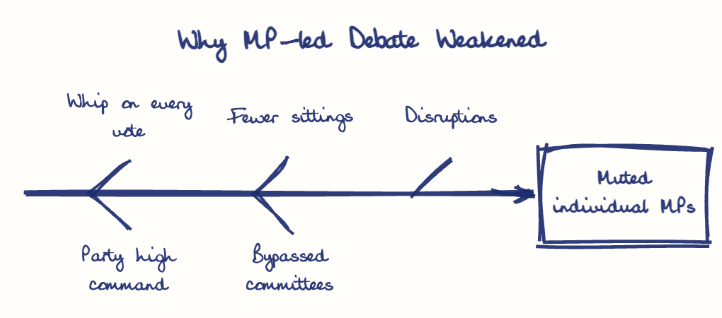
The anti-defection law partly explains the decline of individual MPs: binding members to the whip on every motion ended conscience voting, while fewer sittings and sidelined committees eroded debate independently. PRS data show bill referrals to committees falling from 71% in the 15th Lok Sabha to 25% in the 16th.
Model answer
Ghissu Editorial · Verified 4 Oct 2026 · 277 words
Whip on every motion
Paragraph 2(1)(b), upheld in Kihoto Hollohan (1992), disqualifies any member who defies the whip, so conscience voting ended and speeches rarely change outcomes.
Comparative evidence
British MPs rebelled against three-line whips in the 2019 Brexit votes without losing their seats, showing the Indian law, not discipline alone, removes dissent.
Intention defeated
Defection survived through mass resignations in Karnataka (2019) and Madhya Pradesh (2020), so the cost fell on dissent, not opportunism.
Fewer sittings
The Lok Sabha met over 120 days a year in the 1950s but about 70 by the 2000s, shrinking time for members' speeches.
Bypassed committees
PRS data show bill referrals falling from 71% in the 15th Lok Sabha to 25% in the 16th.
Disruption and guillotine
Adjournments and guillotined demands for grants let much of the Budget pass undebated.
Weak research support
Without personal research staff, few MPs can contest technical bills.
This model answer is indicative and the model can make mistakes; please verify key facts independently.
Practise this question
1Get the answer sheet
Sized for this question.
2Write your answer
Timed, by hand.
3Get it marked
Your score and what to fix.
This chapter in the exam
State Legislatures — Structure2 questions
Asked in 2 of 14 sittings since 2013
Question from the official UPSC Civil Services (Main) Examination 2013 paper. Answer written by Ghissu's engine and checked against our editorial standards. Found an error? Tell us and we correct it within 48 hours.