2013 · GS Paper 4 · Q6(c) · 10 marks
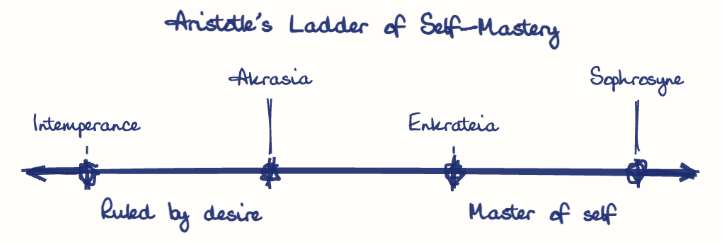
Given below are three quotations of great moral thinkers/philosophers. For each of these quotations, bring out what it means to you in the present context: "I count him braver who overcomes his desires than him who overcomes his enemies." —Aristotle
In short
The quote means that mastering one's own greed, anger and impulses is a harder and nobler courage than defeating an outside enemy. Ashoka's turn from conquest to Dhamma-vijaya after Kalinga, and the inner restraint an officer shows when unobserved, prove the point.
Model answer
Ghissu Editorial · Verified 4 Oct 2026 · 269 words
Courage turned inward
Desire is an enemy that never leaves; one may know the right course and still yield, so Aristotle trusts habit, since we become temperate by doing temperate acts.
Shared wisdom
The Dhammapada holds that one who conquers himself is greater than one who conquers a thousand times a thousand men, and the Gita (6.6) calls the mind a friend only to the self-controlled.
Freedom, not denial
Self-mastery is eudaimonia, a flourishing life in which desires serve reason.
Integrity in office
Corruption is desire winning over duty; the Prevention of Corruption Act, 1988 is an outer wall, but only inner restraint holds when no one is watching.
Consumerism and climate
Mission LiFE (2022) asks for mindful consumption, echoing Gandhi's warning that the earth meets every need but not every greed.
Restraint at the peak
Gandhi called off the Non-Cooperation Movement after Chauri Chaura in 1922, a harder victory over his own momentum than any over the Raj.
This model answer is indicative and the model can make mistakes; please verify key facts independently.
Practise this question
1Get the answer sheet
Sized for this question.
2Write your answer
Timed, by hand.
3Get it marked
Your score and what to fix.
This chapter in the exam
Contributions of moral thinkers and philosophers from the world14 questions
Asked in 11 of 14 sittings since 2013
- 2025What do each of these quotations convey to you in the present context? "The greatest discovery of my generation is that a human being can alter his life by altering his attitudes." – William James
- 2022what do each of the following quotations mean to you? "Judge your success by what you had to give up in order to get it." — Dalai Lama
All 14 questions, sorted by sub-topic, with model answers and practice.
Question from the official UPSC Civil Services (Main) Examination 2013 paper. Answer written by Ghissu's engine and checked against our editorial standards. Found an error? Tell us and we correct it within 48 hours.