2014 · GS Paper 1 · Q7 · 10 marks
In what ways did the naval mutiny prove to be the last nail in the coffin of British colonial aspirations in India?
In short
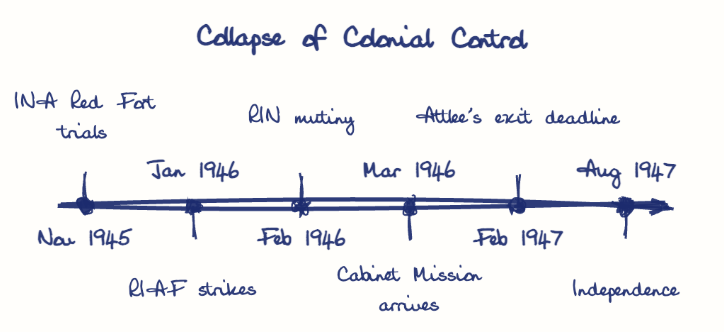
The naval mutiny of February 1946 sealed British rule by proving that the armed forces, the Raj's last loyal pillar, could no longer be trusted against nationalism. A day after it began, Attlee announced the Cabinet Mission on 19 February 1946.
Model answer
Ghissu Editorial · Verified 4 Oct 2026 · 297 words
Loyalty of the forces lost
The Raj rested on a loyal army after 1857; following the INA trials and RIAF strikes, the mutiny showed even the services could not be trusted.
Nationalism in uniform
The Naval Central Strike Committee hoisted the Congress, League and Communist flags together and demanded the release of INA prisoners.
Communal unity
Hindu and Muslim ratings acted together, and Bombay's general strike of 22 February cost over 200 civilian lives.
Timing of the decision
On 19 February 1946, a day after the strike began, Attlee announced the Cabinet Mission.
Governing by force impossible
Wavell warned that India could no longer be held by force, and Attlee later told P.B. Chakrabarti that lost loyalty in the army and navy decided the exit.
A nail, not the hammer
Congress and the League disowned the strike, Patel and Jinnah secured surrender, and war debt and a Labour government already pushed Britain out.
This model answer is indicative and the model can make mistakes; please verify key facts independently.
Practise this question
1Get the answer sheet
Sized for this question.
2Write your answer
Timed, by hand.
3Get it marked
Your score and what to fix.
This chapter in the exam
National Movement: Towards Freedom and Partition (1939–1947)2 questions
Asked in 2 of 14 sittings since 2013
Question from the official UPSC Civil Services (Main) Examination 2014 paper. Answer written by Ghissu's engine and checked against our editorial standards. Found an error? Tell us and we correct it within 48 hours.