2014 · GS Paper 1 · Q13 · 10 marks
The life cycle of a joint family depends on economic factors rather than social values. Discuss.
In short
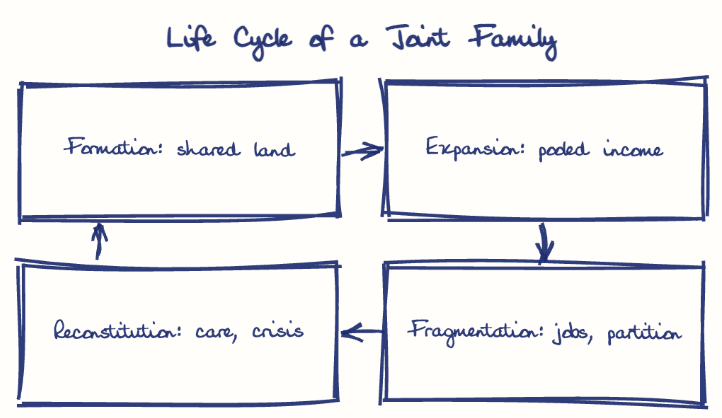
Economic factors such as property, pooled income, land scarcity and urban jobs largely decide when a joint household forms and splits, but social values decide whether jointness survives. I.P. Desai showed that separate households still act jointly in rituals, property and crises.
Model answer
Ghissu Editorial · Verified 4 Oct 2026 · 276 words
Property binds
The Mitakshara coparcenary and the tax status of the Hindu Undivided Family reward keeping land and assets in common.
Pooling builds
Milton Singer (1972) found Madras industrial families pooling capital and management, as Marwari business houses did.
Scarcity splits
An average holding of 1.08 hectares (Agriculture Census 2015-16) cannot feed several brothers, while city jobs pull sons away; the Reliance group itself split in 2005.
Crisis reunites
Costly housing, childcare needs of working couples and the 2020 lockdown's reverse migration brought families back together.
Filial duty
Obligation to aged parents, now backed by the Maintenance and Welfare of Parents and Senior Citizens Act, 2007, keeps them with their sons.
Arranged marriage
About 93% of marriages were arranged in the Lok Foundation-Oxford survey (2018), keeping the kin group at the centre.
Functional jointness
I.P. Desai found separate households still acting jointly in rituals, property and crises, and shared rites such as shraddha keep scattered branches tied to the ancestral home.
This model answer is indicative and the model can make mistakes; please verify key facts independently.
Practise this question
1Get the answer sheet
Sized for this question.
2Write your answer
Timed, by hand.
3Get it marked
Your score and what to fix.
This chapter in the exam
Salient features of Indian Society, Diversity of India23 questions
Asked in 13 of 14 sittings since 2013
- 2026Unity in diversity remains the defining feature of Indian society despite the challenges from communalism and regionalism. Comment.
- 2026Is caste disappearing in urban India? Illustrate your answer with examples.
All 23 questions, sorted by sub-topic, with model answers and practice.
Question from the official UPSC Civil Services (Main) Examination 2014 paper. Answer written by Ghissu's engine and checked against our editorial standards. Found an error? Tell us and we correct it within 48 hours.