2014 · GS Paper 2 · Q3 · 12 marks
The Powers, Privileges and Immunities of Parliament and its Members as envisaged in Article 105 of the Constitution leave room for a large number of un-codified and un-enumerated privileges to continue. Assess the reasons for the absence of legal codification of the parliamentary privileges. How can this problem be addressed?
In short
Parliament has not codified its privileges mainly because members fear that a statute would expose them to Fundamental Rights review and would curb their flexibility and self-judgment. A short law on Australia's 1987 model, protecting only privileges that pass the Sita Soren (2024) necessity test, would resolve the problem.
Model answer
Ghissu Editorial · Verified 4 Oct 2026 · 291 words
Fear of judicial review
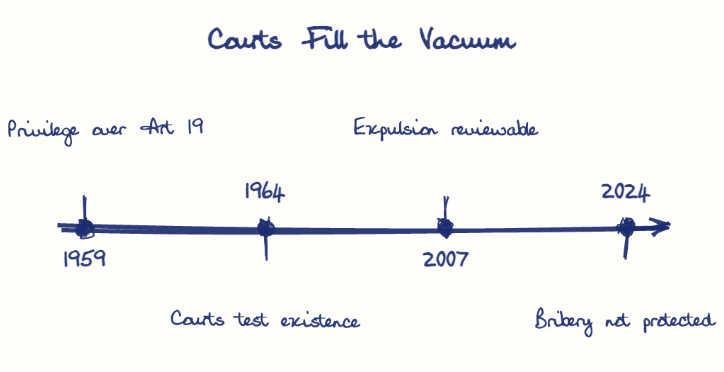
A statute would be "law" under Article 13 and testable against Fundamental Rights, whereas M.S.M. Sharma (1959) let the uncodified privilege prevail over Article 19(1)(a).
Flexibility against new contempts
An open power punishes new obstruction, but enabled Tamil Nadu's 2003 arrest order against The Hindu's journalists and Karnataka's 2017 jail term for two editors.
Claim of sole judgment
The House wants to judge its own privileges, though the Keshav Singh reference (1964) lets courts test whether one exists.
No political will
Members resist trimming their own powers despite the NCRWC (2002) urging a law.
Enact a privileges law
Follow Australia's Parliamentary Privileges Act 1987, which defined contempt, capped penalties and ended expulsion.
Necessity as the filter
Protect only what passes the Sita Soren (2024) test of collective functioning and essential duties, keeping bribery and vandalism outside.
Due process and free press
Give notice, hearing and proportionate penalties, exempt fair reporting, and add a legislators' code of conduct as the 2nd ARC (2007) urged.
This model answer is indicative and the model can make mistakes; please verify key facts independently.
Practise this question
1Get the answer sheet
Sized for this question.
2Write your answer
Timed, by hand.
3Get it marked
Your score and what to fix.
This chapter in the exam
Parliament — Privileges1 question
Asked in 1 of 14 sittings since 2013
Question from the official UPSC Civil Services (Main) Examination 2014 paper. Answer written by Ghissu's engine and checked against our editorial standards. Found an error? Tell us and we correct it within 48 hours.