2014 · GS Paper 2 · Q7 · 12 marks
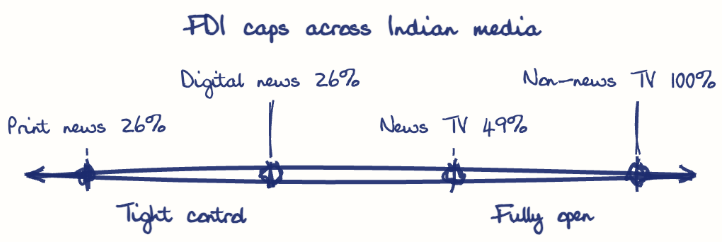
Though 100 percent FDI is already allowed in non-news media like a trade publication and general entertainment channel, the Government is mulling over the proposal for increased FDI in news media for quite some time. What difference would an increase in FDI make ? Critically evaluate the pros and cons.
In short
Higher FDI in news media would bring capital, technology and professional standards but risks foreign influence over public opinion and concentration of ownership. A calibrated rise, such as the 2015 cap of 49% for news television with Indian editorial control and security clearance, balances these concerns.
Model answer
Ghissu Editorial · Verified 4 Oct 2026 · 280 words
Freedom from patrons
Foreign equity would reduce dependence on government advertising and on owners with political stakes, giving editors more room to scrutinise power.
Technology and formats
Star News, backed by Murdoch's Star with NDTV content, launched round-the-clock television news in 1998, showing what foreign capital can add.
Professional standards
Global codes on sourcing and conflicts of interest matter where the Press Council's 2010 report documented widespread paid news.
Opinion and security
A foreign state could use ownership to shape elections and security narratives, which is why Ofcom revoked CGTN's UK licence in 2021.
Concentration of power
The News of the World phone-hacking scandal of 2011 showed how global owners can dominate politics, a risk TRAI's 2014 media ownership report flagged in India.
Weak regulation
News television relies on self-regulation, the Press Council cannot penalise, and layered investments hide beneficial owners, so ratings-driven investors could also crowd out small regional outlets.
This model answer is indicative and the model can make mistakes; please verify key facts independently.
Practise this question
1Get the answer sheet
Sized for this question.
2Write your answer
Timed, by hand.
3Get it marked
Your score and what to fix.
This chapter in the exam
Government Policies, Design & Implementation Issues3 questions
Asked in 3 of 14 sittings since 2013
- 2022The Gati-Shakti Yojana needs meticulous coordination between the government and the private sector to achieve the goal of connectivity. Discuss.
- 2019In the context of neo-liberal paradigm of development planning, multi-level planning is expected to make operations cost-effective and remove many implementation blockages.', Discuss.
Question from the official UPSC Civil Services (Main) Examination 2014 paper. Answer written by Ghissu's engine and checked against our editorial standards. Found an error? Tell us and we correct it within 48 hours.