2014 · GS Paper 3 · Q16 · 12 marks
"The diverse nature of India as a multi-religious and multi-ethnic society is not immune to the impact of radicalism which is seen in her neighbourhood." Discuss along with strategies to be adopted to counter this environment.
In short
India's multi-religious, multi-ethnic society is exposed to radicalism from Pakistan, Bangladesh, Myanmar and Sri Lanka, and needs layered regional, border, legal and community-led strategies to counter it. The 2014 Burdwan blast exposed a Jamaat-ul-Mujahideen Bangladesh module operating inside West Bengal.
Model answer
Ghissu Editorial · Verified 4 Oct 2026 · 268 words
Pakistan's jihadist exports
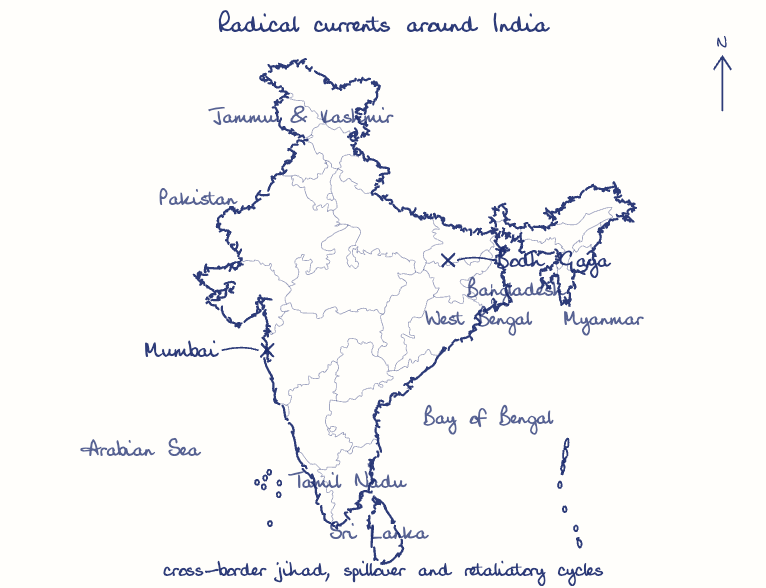
Lashkar-e-Taiba and Jaish-e-Mohammed carry militancy into Jammu and Kashmir and beyond, as the 26/11 Mumbai attacks of 2008 showed.
Spillover from Bangladesh
The Burdwan module showed networks straddling the border, and attacks on Hindu minorities after August 2024 stirred communal anger in India.
Retaliatory cycles
Violence against the Rohingya in Myanmar was cited as the motive for the 2013 Bodh Gaya blasts, and Sri Lanka's 2019 Easter bombers had links to radicals in Tamil Nadu.
Regional cooperation
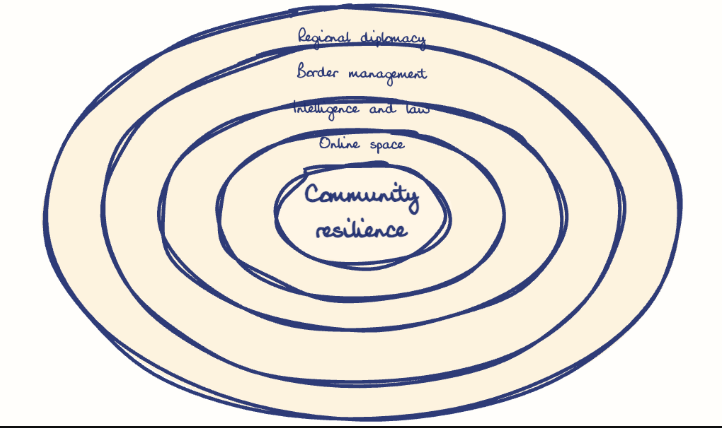
Intelligence sharing with Bangladesh after 2009 helped dismantle ULFA camps there.
Borders and intelligence
The Comprehensive Integrated Border Management System, NATGRID and the Multi-Agency Centre close gaps that cross-border modules exploit.
Law and finance
The UAPA and the NIA, strengthened in 2019, with FATF-standard terror-finance tracking, cut off funds and networks.
Community-led deradicalisation
Maharashtra's programme with families and clerics, and community policing urged by the 2nd ARC, build trust that force cannot.
This model answer is indicative and the model can make mistakes; please verify key facts independently.
Practise this question
1Get the answer sheet
Sized for this question.
2Write your answer
Timed, by hand.
3Get it marked
Your score and what to fix.
This chapter in the exam
Extremism17 questions
Asked in 11 of 14 sittings since 2013
- 2026Separatist movements have been one of the major factors contributing to militancy and instability in Jammu & Kashmir (J&K). Bring out actions taken by the Government to bring J&K into national mainstream. Discuss pre and post abrogation status of Articles 370 and 35A. Also bring out positive impacts of abrogation of both articles in mainstreaming the state. (Answer in 250 words)
- 2025The Government of India recently stated that Left Wing Extremism (LWE) will be eliminated by 2026. What do you understand by LWE and how are the people affected by it ? What measures have been taken by the government to eliminate LWE ?
All 17 questions, sorted by sub-topic, with model answers and practice.
Question from the official UPSC Civil Services (Main) Examination 2014 paper. Answer written by Ghissu's engine and checked against our editorial standards. Found an error? Tell us and we correct it within 48 hours.