2014 · GS Paper 4 · Q3(b) · 10 marks
"Human beings should always be treated as 'ends' in themselves and never as merely 'means'." Explain the meaning and significance of this statement, giving its implications in the modern techno-economic society.
In short
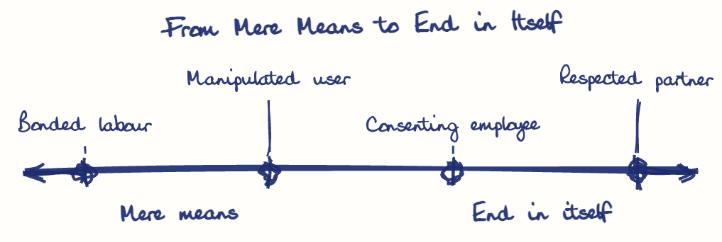
Kant's statement means every person has dignity rather than a price, so others may never be used merely as tools without consent and regard for their own ends. In a techno-economic society this demands consent-based data use, as in the Digital Personal Data Protection Act, 2023.
Model answer
Ghissu Editorial · Verified 4 Oct 2026 · 277 words
Dignity, not price
Things have a price, but a rational person has dignity, an irreplaceable worth, because he sets his own ends; the wrong lies in using others merely as tools, without consent.
Check on utilitarian sums
The principle forbids sacrificing one person for a larger total, so no welfare gain justifies torture, forced sterilisation or a fake encounter.
Constitutional echo
The Preamble's "dignity of the individual", Article 21 in Puttaswamy (2017) and Ambedkar's 1949 call for "one man one value" carry the same idea.
Labour
The Rana Plaza collapse (2013), killing over 1,100 garment workers, showed people treated as inputs; the Code on Social Security, 2020 recognises gig workers.
Data
Cambridge Analytica (2018) used Facebook profiles without consent; the Digital Personal Data Protection Act, 2023 makes consent the rule.
Design and AI
The CCPA's dark-pattern guidelines (2023) ban manipulative tricks, and automated hiring or credit decisions need human review so a person is not reduced to a score.
This model answer is indicative and the model can make mistakes; please verify key facts independently.
Practise this question
1Get the answer sheet
Sized for this question.
2Write your answer
Timed, by hand.
3Get it marked
Your score and what to fix.
This chapter in the exam
Contributions of moral thinkers and philosophers from the world14 questions
Asked in 11 of 14 sittings since 2013
- 2025What do each of these quotations convey to you in the present context? "The greatest discovery of my generation is that a human being can alter his life by altering his attitudes." – William James
- 2022what do each of the following quotations mean to you? "Judge your success by what you had to give up in order to get it." — Dalai Lama
All 14 questions, sorted by sub-topic, with model answers and practice.
Question from the official UPSC Civil Services (Main) Examination 2014 paper. Answer written by Ghissu's engine and checked against our editorial standards. Found an error? Tell us and we correct it within 48 hours.