2015 · GS Paper 1 · Q18 · 12 marks
How far do you agree that the behavior of the Indian monsoon has been changing due to humanizing landscapes? Discuss.
In short
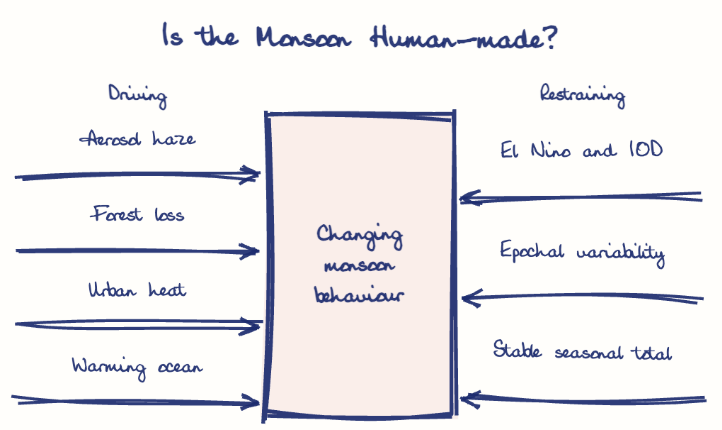
Humanised landscapes are largely, though not wholly, changing the Indian monsoon: aerosols, deforestation, cities and a warming ocean are making its rains weaker in total and more extreme, while El Nino and the Indian Ocean Dipole still set yearly swings. Summer monsoon rainfall fell about 6% between 1951 and 2015.
Model answer
Ghissu Editorial · Verified 4 Oct 2026 · 298 words
Aerosol haze
Bollasina and colleagues (Science, 2011) tied the post-1950 weakening mainly to man-made aerosols cooling the Indo-Gangetic plain.
Land-use change
A 2016 study in Scientific Reports showed that converting forest to farmland cuts evapotranspiration, moisture recycling and rainfall.
Urban heat islands
Cities are linked to fiercer local downpours that paved land turns into floods, as with the 944 mm that fell on Mumbai's Santacruz on 26 July 2005.
Warming ocean
Roxy and colleagues found a faster-warming Indian Ocean weakens the land-sea contrast, and recorded a threefold rise in widespread extreme rain over central India.
Oscillations
El Nino droughts in 2009 and 2015 and the positive Indian Ocean Dipole of 2019 show natural cycles still set yearly totals.
Epochal variability
All-India rainfall moves through wet and dry epochs of about three decades, so short trends are easy to over-read.
Stable total
IMD revised the Long Period Average only from 88 cm to 87 cm, so the change is more in pattern than in quantity.
This model answer is indicative and the model can make mistakes; please verify key facts independently.
Practise this question
1Get the answer sheet
Sized for this question.
2Write your answer
Timed, by hand.
3Get it marked
Your score and what to fix.
This chapter in the exam
Climate, Vegetation and Soils2 questions
Asked in 2 of 14 sittings since 2013
Question from the official UPSC Civil Services (Main) Examination 2015 paper. Answer written by Ghissu's engine and checked against our editorial standards. Found an error? Tell us and we correct it within 48 hours.