2015 · GS Paper 1 · Q19 · 12 marks
Smart cities in India cannot sustain without smart villages. Discuss this statement in the backdrop of rural urban integration.
In short
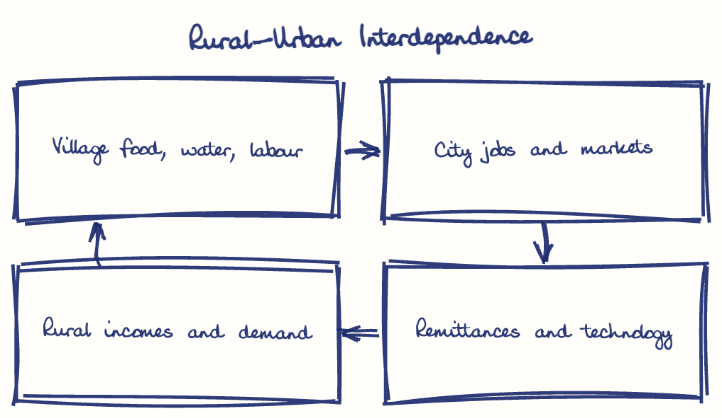
Smart cities cannot be sustained in isolation because villages supply their food, water and labour, and rural distress returns to cities as migration, slums and pollution. The Shyama Prasad Mukherji Rurban Mission (2016) responds by developing 300 village clusters with urban amenities, extending Kalam's PURA idea.
Model answer
Ghissu Editorial · Verified 4 Oct 2026 · 269 words
Distress migration
The Economic Survey 2016-17 estimated about 90 lakh inter-state migrants a year, many fleeing farm distress and swelling urban slums.
Shared environment
Stubble burning in Punjab and Haryana worsens Delhi's winter smog, so a city's air quality depends on smarter farm practices in its hinterland.
Resource catchment
Mumbai drinks from dams like Bhatsa and Vaitarna in rural Thane and Nashik, so rural watersheds decide urban water security.
Blurring boundaries
Census towns rose from 1,362 in 2001 to 3,894 in 2011, as large villages turned urban without planning.
Rurban clusters
The Shyama Prasad Mukherji Rurban Mission (2016) develops 300 village clusters, extending Kalam's PURA idea.
Digital and market links
BharatNet and e-NAM link villagers to city services and buyers without migration.
Cities still lead growth
Agglomeration matters too; World Bank researchers (2021) find doubling city size raises productivity by about 12% in India, while panchayats lack funds and planners for smart services.
This model answer is indicative and the model can make mistakes; please verify key facts independently.
Practise this question
1Get the answer sheet
Sized for this question.
2Write your answer
Timed, by hand.
3Get it marked
Your score and what to fix.
This chapter in the exam
Urbanization, their problems and their remedies5 questions
Asked in 5 of 14 sittings since 2013
- 2022How is the growth of Tier 2 cities related to the rise of a new middle class with an emphasis on the culture of consumption ?
- 2017"The growth of cities as I.T. hubs has opened up new avenues of employment, but has also created new problems." Substantiate this statement with examples.
All 5 questions, sorted by sub-topic, with model answers and practice.
Question from the official UPSC Civil Services (Main) Examination 2015 paper. Answer written by Ghissu's engine and checked against our editorial standards. Found an error? Tell us and we correct it within 48 hours.