2015 · GS Paper 2 · Q1 · 12 marks
Discuss the possible factors that inhibit India from enacting for its citizens a uniform civil code as provided for in the Directive Principles of State Policy.
In short
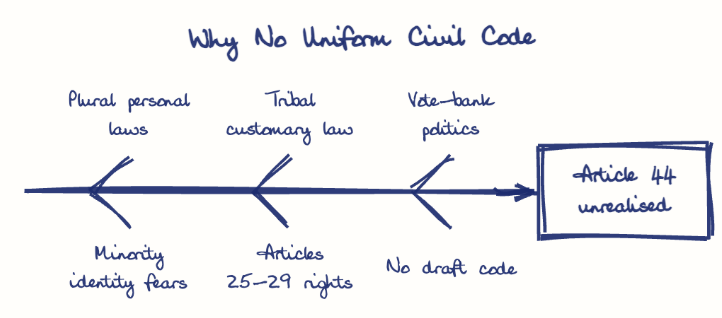
India has not enacted a uniform civil code because plural personal laws, minority fears of assimilation, tribal customary safeguards, non-justiciability and electoral caution stand in the way. The 21st Law Commission (2018) even called a UCC neither necessary nor desirable at that stage.
Model answer
Ghissu Editorial · Verified 4 Oct 2026 · 290 words
Legal pluralism
Codified Hindu law of 1955-56, Muslim personal law, Goa's 1867 civil code and tribal customs leave no single national template.
Minority insecurity
Uniformity is read as assimilation; the Shah Bano backlash produced the Muslim Women (Protection of Rights on Divorce) Act, 1986.
Tribal autonomy
Articles 371A, 371G and the Sixth Schedule protect customary marriage and inheritance laws in the Northeast.
Rights in tension
Articles 25 to 29 protect religious and cultural freedom, while Article 37 makes Article 44 non-justiciable, so courts cannot compel a code.
Concurrent subject
Entry 5 of the Concurrent List lets States legislate differently on family law.
No draft, no consensus
The 21st Law Commission (2018) found a UCC "neither necessary nor desirable at this stage", and parties fear losing community votes.
Piecemeal reform
Build on Shayara Bano (2017) and the 2019 triple talaq law to end discriminatory rules within each personal law.
Consent-based code
Simplify the Special Marriage Act, 1954, as a voluntary common code and draft a national code through wide consultation, learning from Goa and Uttarakhand (2024).
This model answer is indicative and the model can make mistakes; please verify key facts independently.
Practise this question
1Get the answer sheet
Sized for this question.
2Write your answer
Timed, by hand.
3Get it marked
Your score and what to fix.
This chapter in the exam
Significant Provisions — DPSPs & Fundamental Duties1 question
Asked in 1 of 14 sittings since 2013
Question from the official UPSC Civil Services (Main) Examination 2015 paper. Answer written by Ghissu's engine and checked against our editorial standards. Found an error? Tell us and we correct it within 48 hours.