2015 · GS Paper 3 · Q1 · 12 marks
The nature of economic growth in India in recent times is often described as jobless growth. Do you agree with this view? Give arguments in favour of your answer.
In short
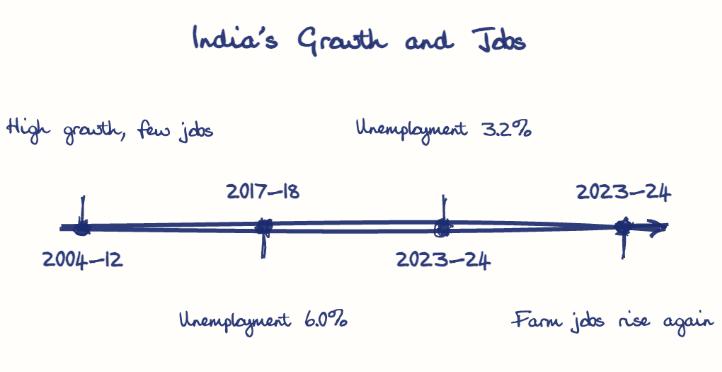
India's growth has been job-poor rather than strictly jobless: the 2004-12 boom added few jobs, and recent job gains are mostly low-quality self-employment and farm work. Employment rose only from 459.4 million in 2004-05 to 474.2 million in 2011-12 despite about 8% annual growth.
Model answer
Ghissu Editorial · Verified 4 Oct 2026 · 282 words
Jobs barely rose in the boom
Employment grew from 459.4 million in 2004-05 to only 474.2 million in 2011-12 (NSSO), under 15 million jobs in seven years of about 8% growth.
Skipped manufacturing stage
Capital- and skill-intensive services led growth, while labour-absorbing manufacturing stayed near 15-17% of GVA.
Informal work
The NCEUS found over nine in ten workers informal in 2004-05, and farm leavers moved mostly into insecure construction jobs.
Weak labour absorption
A rising working-age share added over 0.5 points a year to per capita growth across states, but a falling employment-to-working-age ratio cut 0.27 points (Azim Premji University).
Employment has risen since 2017
Jobs grew from 47.5 crore in 2017-18 to 64.33 crore in 2023-24, and unemployment fell from 6.0% to 3.2% (PLFS, 2025), with net EPFO additions doubling to 1.29 crore by 2024-25.
But low-quality growth
Farm employment rose back to 283.4 million in 2023-24 and labour productivity fell 0.5% that year (Azim Premji University).
This model answer is indicative and the model can make mistakes; please verify key facts independently.
Practise this question
1Get the answer sheet
Sized for this question.
2Write your answer
Timed, by hand.
3Get it marked
Your score and what to fix.
This chapter in the exam
Employment3 questions
Asked in 3 of 14 sittings since 2013
- 2023Most of the unemployment in India is structural in nature. Examine the methodology adopted to compute unemployment in the country and suggest improvements.
- 2014"While we flaunt India's demographic dividend, we ignore the dropping rates of employability." What are we missing while doing so? Where will the jobs that India desperately needs come from? Explain.
Question from the official UPSC Civil Services (Main) Examination 2015 paper. Answer written by Ghissu's engine and checked against our editorial standards. Found an error? Tell us and we correct it within 48 hours.