2015 · GS Paper 3 · Q6 · 12 marks
What are the impediments in marketing and supply chain management in developing the food processing industry in India ? Can e-commerce help in overcoming these bottlenecks ?
In short
India's food processing industry is held back by fragmented supply, a long APMC intermediary chain, cold-chain gaps and regulatory barriers. E-commerce, through e-NAM, B2B platforms and ONDC, can largely fix price discovery and intermediation but not the physical cold-chain and storage gaps.
Model answer
Ghissu Editorial · Verified 4 Oct 2026 · 269 words
Fragmented supply
Small, ungraded lots from millions of holdings raise processors' aggregation costs and make quality inconsistent.
Intermediary chain
Under the APMC system, village traders, commission agents and wholesalers each add a margin, so farmers earn less and processors pay more.
Cold-chain gaps
Too few pack-houses, reefer vehicles and rural roads let perishables rot in transit.
Regulatory barriers
Mandi licensing, Essential Commodities Act stock limits and weak testing deter direct buying.
Price discovery
e-NAM (2016) links more than 1,000 mandis online, letting processors bid beyond the local market and farmers see competing prices.
Fewer intermediaries
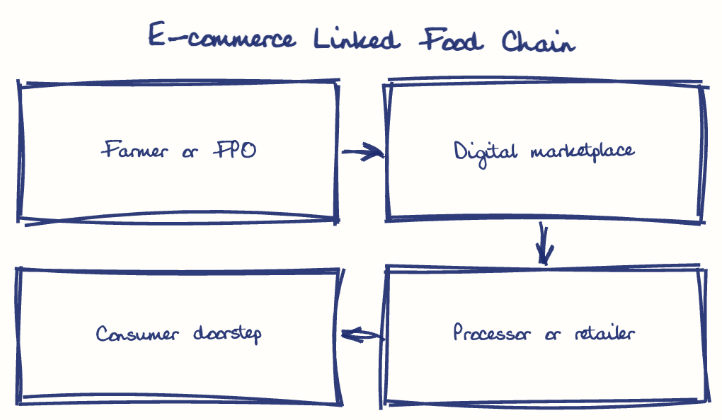
Ninjacart moves produce from farmers to retailers within a day, and ONDC (2022) lets FPOs sell processed goods nationally.
Demand data
Platforms like BigBasket give processors real-time demand signals and let small brands reach urban buyers without costly distribution networks.
Limits
E-commerce cannot build cold storage, grading or roads, and low digital literacy and thin inter-state trade on e-NAM restrict its reach.
This model answer is indicative and the model can make mistakes; please verify key facts independently.
Practise this question
1Get the answer sheet
Sized for this question.
2Write your answer
Timed, by hand.
3Get it marked
Your score and what to fix.
This chapter in the exam
Food Processing and Related Industries7 questions
Asked in 7 of 14 sittings since 2013
- 2025Examine the scope of the food processing industries in India. Elaborate the measures taken by the government in the food processing industries for generating employment opportunities.
- 2022Elaborate the scope and significance of the food processing industry in India.
All 7 questions, sorted by sub-topic, with model answers and practice.
Question from the official UPSC Civil Services (Main) Examination 2015 paper. Answer written by Ghissu's engine and checked against our editorial standards. Found an error? Tell us and we correct it within 48 hours.