2015 · GS Paper 4 · Q12 · 20 marks
There is a disaster-prone State having frequent landslides, forest fires, cloudbursts, flash floods and earthquakes, etc. Some of these are seasonal and often unpredictable. The magnitude of the disaster is always unanticipated. During one of the seasons, a cloudburst caused devastating floods and landslides leading to high casualties. There was major damage to infrastructure like roads, bridges and power generating units. This led to more than 100000 pilgrims, tourists and other locals trapped across different routes and locations. The people trapped in your area of responsibility included senior citizens, patients in hospitals, women and children, hikers, tourists, ruling party's regional president along with his family, additional chief secretary of the neighbouring State and prisoners in jail. As a civil services officer of the State, what would be the order in which you would rescue these people and why? Give justifications.
In short
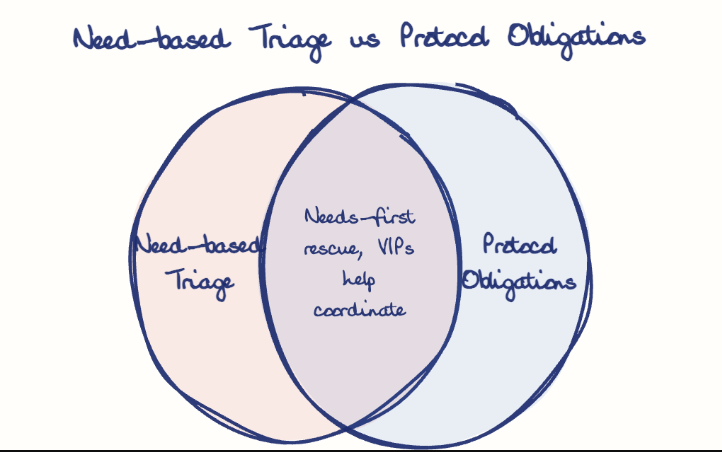
I would rescue hospital patients first, then children, women and senior citizens, then hikers, tourists and locals, with the party president and the ACS placed by need and prisoners moved last under escort. The order rests on need-based triage and Rawls's Difference Principle, not on status.
Model answer
Ghissu Editorial · Verified 4 Oct 2026 · 300 words
Hospital patients first
Critically ill patients die within hours once power and supplies fail, so they are airlifted first after START triage.
Children, women, elderly
Children, pregnant women and senior citizens cannot walk out over broken roads; families move together.
Hikers, tourists, locals
Healthy adults can survive in camps and walk out with guides, so they are sequenced by the danger at their spot.
Party president and ACS by need
They are rescued in the category their condition places them in, not by office; the ACS can coordinate with his State.
Prisoners under escort
They are last unless the jail is threatened, then shifted under police escort.
Imminence of death
Parmanand Katara (1989) [case] made preserving life the paramount duty in an emergency.
Equality before rescue
Nolan's Objectivity [committee/report] and Article 14 rule out VIP-first Dual-Standard Practice driven by the Halo Effect.
Dignity for prisoners
Sunil Batra (1978) [case] held that prisoners keep their fundamental rights.
A set order saves lives
Odisha's evacuation of about 1.2 million people before Cyclone Fani in 2019 [current event] showed this.
This model answer is indicative and the model can make mistakes; please verify key facts independently.
Practise this question
1Get the answer sheet
Sized for this question.
2Write your answer
Timed, by hand.
3Get it marked
Your score and what to fix.
This chapter in the exam
Disaster and Emergency Response6 questions
Asked in 6 of 14 sittings since 2013
- 2026Rajapuram is a border district. Jhara and Biru, its two major communities are in continual conflict with each other. The social fabric is fractured and demands mending. Ethnic tensions between the two communities have erupted into violence resulting in a large number of deaths. The stated causes are conflicting land claims, uneven resource allocation and inadequate political representation in government bodies. Separate relief camps had to be created for the two communities. The situation is volatile and appears to be getting out of control. Rajan has been appointed the District Magistrate (DM) of Rajapuram and tasked to quickly get the situation under control. His immediate tasks include restoring administrative authority, reopening the highway and initiating peace talks. On taking over his appointment, Rajan realized that the inter-community rivalry had even seeped into the local administration and police. With functional neutrality being the immediate casualty, it had made both communities distrustful of the government. The neighbouring country could utilize the opportunity to spur insurgent activity and further aggravate the situation. Rajan favoured a controlled approach starting with opening the highway to restore food and medical supplies. He toyed with the idea of requisitioning CRPF units to help restore administrative control. (a) Discuss the ethical issues that need to be addressed in this case. (b) What are the options open to Rajan? Which option would ensure protection of his non-partisan image without compromising ethics?
- 2025Vijay was Deputy Commissioner of remote district of Hilly Northern State of the country for the last two years. In the month of August heavy rains lashed the complete state followed by cloud burst in the upper reaches of the said district. The damage was very heavy in the complete state especially in the affected district. The complete road network and telecommunication were disrupted and the buildings were damaged extensively. People's houses have been destroyed and they were forced to stay in open. More than 200 people have been killed and about 5000 were badly injured. The Civil Administration under Vijay got activated and started conducting rescue and relief operations. Temporary shelter camps and hospitals were established to provide shelter and medical facilities to the homeless and injured people. Helicopter services were pressed in, for evacuating sick and old people from remote areas. Vijay got a message from his hometown in Kerala that his mother was seriously sick. After two days Vijay received the unfortunate message that his mother has expired. Vijay has no close relative except one elder sister who was US citizen and staying there for last several years. In the meantime, the situation in the affected district deteriorated further due to resumption of heavy rains after a gap of five days. At the same time, continuous messages were coming on his mobile from his hometown to reach at the earliest for performing last rites of his mother. (a) What are the options available with Vijay? (b) What are the ethical dilemma being faced by Vijay? (c) Critically evaluate and examine each of these options identified by Vijay. (d) Which of the options, do you think, would be most appropriate for Vijay to adopt and why?
All 6 questions, sorted by sub-topic, with model answers and practice.
Question from the official UPSC Civil Services (Main) Examination 2015 paper. Answer written by Ghissu's engine and checked against our editorial standards. Found an error? Tell us and we correct it within 48 hours.