2016 · GS Paper 3 · Q4 · 12 marks
What are 'Smart Cities'? Examine their relevance for urban development in India. Will it increase rural-urban differences? Give arguments for 'Smart Villages' in the light of PURA and RURBAN Mission.
In short
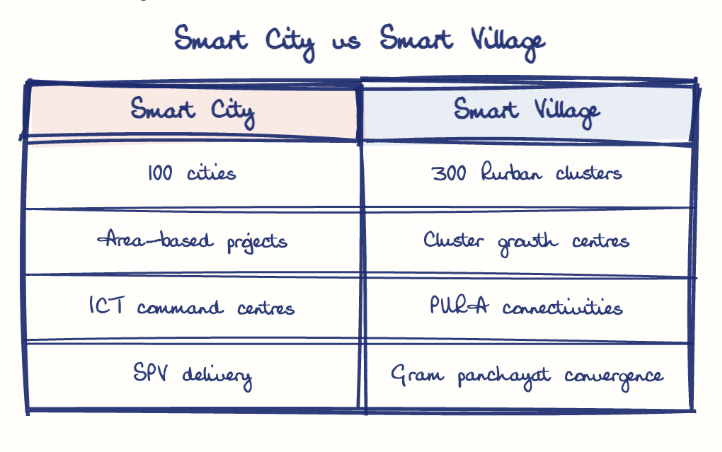
Smart cities, under the 2015 Mission, use core infrastructure and technology-led solutions to make 100 cities productive and liveable, but they can widen rural-urban gaps unless villages get matching investment. PURA and the 2016 Rurban Mission's 300 clusters make the case for smart villages.
Model answer
Ghissu Editorial · Verified 4 Oct 2026 · 298 words
Engines of growth
Doubling city size raises productivity by about 12% in India (World Bank paper, 2021).
Data-driven governance
Integrated Command and Control Centres in all 100 cities manage traffic and water, and served as Covid war rooms.
Liveable cities
Pune's cycle plan and Surat's flood early-warning system show how mobility and resilience can be built into planning.
Risk of widening gaps
Funds and talent concentrate in 100 chosen cities and pull migrants faster than towns can absorb them.
Two-way link
Cities create markets and remittances for villages, so gaps widen only when villages lack their own investment.
PURA's vision
Dr Kalam's Providing Urban Amenities in Rural Areas linked physical, electronic and knowledge connectivity to create economic connectivity.
Rurban Mission (2016)
It set out to develop 300 clusters with critical gap funding, converging schemes for roads, skills and digital services.
Hidden urbanisation
About 10.4 crore Indians live in some 8,600 urban-like settlements governed as rural (IIHS report to the 16th Finance Commission, 2025), and smart villages give them planned growth.
This model answer is indicative and the model can make mistakes; please verify key facts independently.
Practise this question
1Get the answer sheet
Sized for this question.
2Write your answer
Timed, by hand.
3Get it marked
Your score and what to fix.
This chapter in the exam
Infrastructure (etc.)4 questions
Asked in 4 of 14 sittings since 2013
- 2023What is the status of digitalization in the Indian economy? Examine the problems faced in this regard and suggest improvements.
- 2021"Investment in infrastructure is essential for more rapid and inclusive economic growth." Discuss in the light of India's experience.
All 4 questions, sorted by sub-topic, with model answers and practice.
Question from the official UPSC Civil Services (Main) Examination 2016 paper. Answer written by Ghissu's engine and checked against our editorial standards. Found an error? Tell us and we correct it within 48 hours.