2016 · GS Paper 4 · Q3(a) · 10 marks
Analyse John Rawls's concept of social justice in the Indian context.
In short
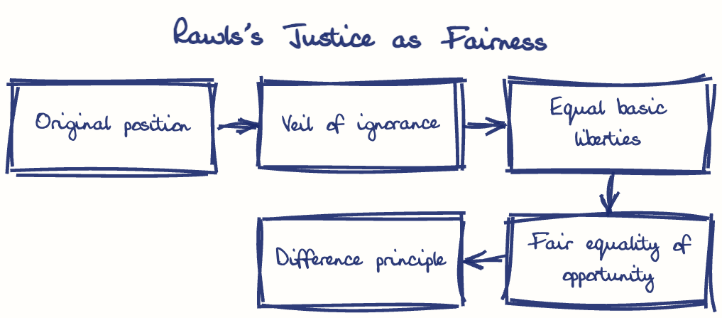
Rawls defines social justice as fairness chosen behind a veil of ignorance: equal liberties first, and inequality only where it benefits the least advantaged. India's Constitution echoes this through Part III, Articles 15(4), 16(4) and 38(2), though caste-based group disadvantage tests the theory's limits.
Model answer
Ghissu Editorial · Verified 4 Oct 2026 · 275 words
Fair starting point
Behind a veil of ignorance, not knowing their caste, class or talent, people would choose rules that protect the worst off.
Two principles
Equal basic liberties come first; inequality is allowed only with fair equality of opportunity and if it benefits the least advantaged, the difference principle.
Equal liberty
Part III, widened in Maneka Gandhi (1978) and Puttaswamy (2017), secures dignity and fair procedure.
Fair opportunity
Articles 15(4) and 16(4), the creamy-layer filter of Indra Sawhney (1992) and the RTE Act's 25% private-school quota seek opportunity in fact.
Least advantaged first
Article 38(2) asks the State to minimise income inequality, and MGNREGA (2005) and the National Food Security Act (2013) put a floor under the poorest, much like Antyodaya.
Limits
Rawls reasons about individuals in an ideal society, while Indian disadvantage is inherited by caste groups; Amartya Sen (2009) urges removing real injustices (nyaya) over perfecting institutions (niti).
This model answer is indicative and the model can make mistakes; please verify key facts independently.
Practise this question
1Get the answer sheet
Sized for this question.
2Write your answer
Timed, by hand.
3Get it marked
Your score and what to fix.
This chapter in the exam
Contributions of moral thinkers and philosophers from the world14 questions
Asked in 11 of 14 sittings since 2013
- 2025What do each of these quotations convey to you in the present context? "The greatest discovery of my generation is that a human being can alter his life by altering his attitudes." – William James
- 2022what do each of the following quotations mean to you? "Judge your success by what you had to give up in order to get it." — Dalai Lama
All 14 questions, sorted by sub-topic, with model answers and practice.
Question from the official UPSC Civil Services (Main) Examination 2016 paper. Answer written by Ghissu's engine and checked against our editorial standards. Found an error? Tell us and we correct it within 48 hours.