2016 · GS Paper 4 · Q1(a) · 10 marks
Explain how ethics contributes to social and human well-being.
In short
Ethics contributes to human well-being by giving inner peace, self-regulation and lasting fulfilment, and to social well-being by building trust, justice and peaceful cooperation. Robert Putnam's 1993 study linked civic trust in Italian regions to better-performing governments.
Model answer
Ghissu Editorial · Verified 4 Oct 2026 · 270 words
Inner peace
A clear conscience frees the mind from guilt and fear; the Buddha's Eightfold Path treats right action as the road out of suffering.
Flourishing
Ethics points to eudaimonia, Aristotle's lasting fulfilment, rather than the fleeting pleasure that consumerism sells.
Self-regulation
Self-restraint protects health and relationships, and the Gita's Nishkama Karma, duty without attachment to its fruits, eases the anxiety of outcomes.
Dignity
Kant's rule of treating every person as an end, never merely as a means, makes family and friendship respectful.
Trust
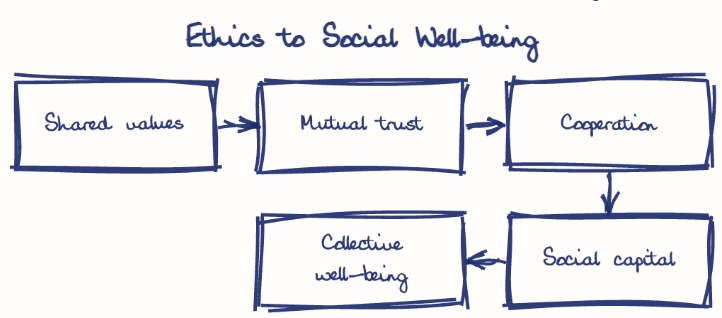
Robert Putnam's "Making Democracy Work" (1993) found that Italian regions rich in civic trust had better-performing governments.
Justice
Laws are ethics codified; Article 17 abolished untouchability and the Rights of Persons with Disabilities Act, 2016 turned dignity into enforceable rights.
Conflict resolution
Gandhi's intervention in the 1918 Ahmedabad mill strike settled a wage dispute through a fast and agreed arbitration instead of violence.
Care for nature
The Bishnois of Khejarli died in 1730 protecting trees, and sacred groves still conserve biodiversity.
This model answer is indicative and the model can make mistakes; please verify key facts independently.
Practise this question
1Get the answer sheet
Sized for this question.
2Write your answer
Timed, by hand.
3Get it marked
Your score and what to fix.
This chapter in the exam
Essence, determinants and consequences of Ethics in human actions12 questions
Asked in 9 of 14 sittings since 2013
- 2026Shakespeare in Henry IV says, "The arms are fair when the intent of bearing them is just". What ethical implications does this have in governance?
- 2024"The concept of Just and Unjust is contextual. What was just a year back, may turn out to be unjust in today's context. Changing context should be constantly under scrutiny to prevent miscarriage of justice." Examine the above statement with suitable examples.
All 12 questions, sorted by sub-topic, with model answers and practice.
Question from the official UPSC Civil Services (Main) Examination 2016 paper. Answer written by Ghissu's engine and checked against our editorial standards. Found an error? Tell us and we correct it within 48 hours.