2017 · GS Paper 3 · Q19 · 15 marks
Mob violence is emerging as a serious law and order problem in India. By giving suitable examples, analyze the causes and consequences of such violence.
In short
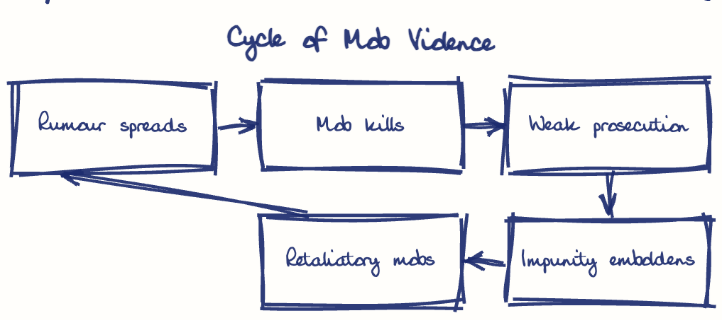
Mob violence in India stems from viral rumours, identity polarisation, a justice deficit and impunity, and it erodes the rule of law, social cohesion and livelihoods. Cases from Dadri (2015) and Alwar (2017) to Dhule (2018) led the Supreme Court in Tehseen Poonawalla (2018) to issue anti-lynching guidelines.
Model answer
Ghissu Editorial · Verified 4 Oct 2026 · 301 words
Viral rumours
WhatsApp child-lifting rumours led to seven lynchings in Jharkhand in May 2017 and five in Dhule, Maharashtra in July 2018.
Identity polarisation
Cow vigilantes killed dairy farmer Pehlu Khan at Alwar in April 2017 while he transported cattle he had bought.
Faith deficit in justice
With over five crore cases pending, crowds seek "instant justice", as when a mob dragged a rape accused out of Dimapur jail in 2015.
Impunity
Crowd anonymity and the 2019 acquittal of all accused in the Pehlu Khan case tell mobs they can act without cost.
Rule of law eroded
Lynching denies life and fair trial under Article 21, and a mob killed Inspector Subodh Kumar Singh at Bulandshahr in 2018.
Social fabric frayed
The 2016 Una flogging of Dalit tanners sparked statewide protests and deepened fear among vulnerable groups.
Economic and security cost
Fear disrupts the cattle trade, and polarisation feeds radicalisation.
Law and guidelines
Enforce Section 103(2) of the Bharatiya Nyaya Sanhita, 2023 and the Tehseen Poonawalla duties of nodal officers, fast-track trials and compensation.
Trust and truth
Bhiwandi-style mohalla committees and digital literacy stop rumours before mobs form.
This model answer is indicative and the model can make mistakes; please verify key facts independently.
Practise this question
1Get the answer sheet
Sized for this question.
2Write your answer
Timed, by hand.
3Get it marked
Your score and what to fix.
This chapter in the exam
Extremism17 questions
Asked in 11 of 14 sittings since 2013
- 2026Separatist movements have been one of the major factors contributing to militancy and instability in Jammu & Kashmir (J&K). Bring out actions taken by the Government to bring J&K into national mainstream. Discuss pre and post abrogation status of Articles 370 and 35A. Also bring out positive impacts of abrogation of both articles in mainstreaming the state. (Answer in 250 words)
- 2025The Government of India recently stated that Left Wing Extremism (LWE) will be eliminated by 2026. What do you understand by LWE and how are the people affected by it ? What measures have been taken by the government to eliminate LWE ?
All 17 questions, sorted by sub-topic, with model answers and practice.
Question from the official UPSC Civil Services (Main) Examination 2017 paper. Answer written by Ghissu's engine and checked against our editorial standards. Found an error? Tell us and we correct it within 48 hours.