2017 · GS Paper 3 · Q10 · 10 marks
The North-East region of India has been infested with insurgency for a very long time. Analyze the major reasons for the survival of armed insurgency in this region.
In short
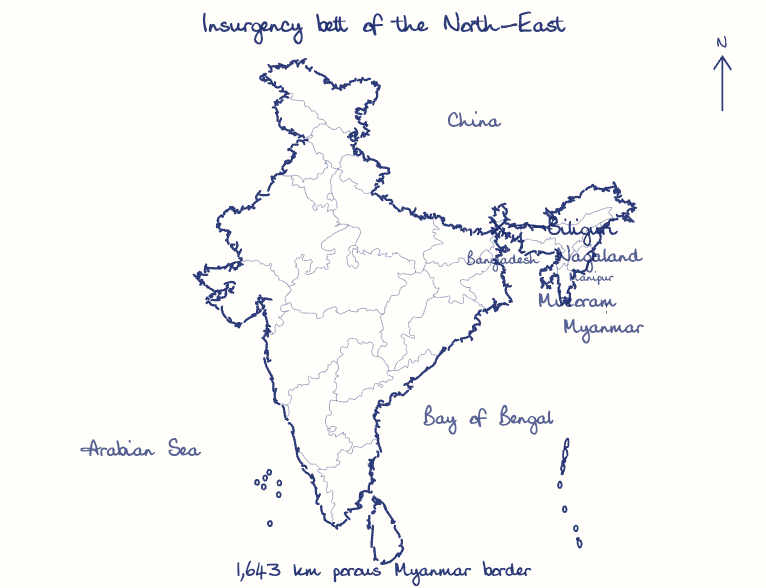
Armed insurgency survives in the North-East because overlapping ethnic homeland claims, unsettled talks and AFSPA-driven alienation combine with porous borders, foreign sanctuaries and an extortion economy. The 1,643 km Myanmar border, with camps in Sagaing, remains its key lifeline.
Model answer
Ghissu Editorial · Verified 4 Oct 2026 · 273 words
Competing homelands
Over 200 ethnic groups claim overlapping lands, so Greater Nagalim collides with Manipur's integrity, and the Meitei-Kuki conflict since 2023 has revived armed mobilisation.
Talks without closure
The 2015 Framework Agreement with the NSCN-IM is stuck over a flag and constitution, while ceasefire camps let cadres keep arms and recruit.
Alienation
AFSPA, 1958 and the Oting firing of December 2021, which killed at least 13 civilians, feed resentment and recruitment, as do scarce jobs and a sense of neglect by the "mainland".
Porous borders
The 1,643 km Myanmar border and the Free Movement Regime give cadres camps in Sagaing, and the 2021 coup has loosened Myanmar's control.
External patrons
China once trained Naga and Mizo rebels, and Bangladesh sheltered ULFA until its post-2009 crackdown.
Conflict economy
Extortion "taxes" on traders and contractors and the Golden Triangle drug route make insurgency self-financing.
Hostile terrain
Forested hills and the narrow Siliguri Corridor slow operations and development.
This model answer is indicative and the model can make mistakes; please verify key facts independently.
Practise this question
1Get the answer sheet
Sized for this question.
2Write your answer
Timed, by hand.
3Get it marked
Your score and what to fix.
This chapter in the exam
Extremism17 questions
Asked in 11 of 14 sittings since 2013
- 2026Separatist movements have been one of the major factors contributing to militancy and instability in Jammu & Kashmir (J&K). Bring out actions taken by the Government to bring J&K into national mainstream. Discuss pre and post abrogation status of Articles 370 and 35A. Also bring out positive impacts of abrogation of both articles in mainstreaming the state. (Answer in 250 words)
- 2025The Government of India recently stated that Left Wing Extremism (LWE) will be eliminated by 2026. What do you understand by LWE and how are the people affected by it ? What measures have been taken by the government to eliminate LWE ?
All 17 questions, sorted by sub-topic, with model answers and practice.
Question from the official UPSC Civil Services (Main) Examination 2017 paper. Answer written by Ghissu's engine and checked against our editorial standards. Found an error? Tell us and we correct it within 48 hours.