2017 · GS Paper 4 · Q5(a) · 10 marks
"Great ambition is the passion of a great character. Those endowed with it may perform very good or very bad acts. All depends on the principles which direct them." — Napoleon Bonaparte. Stating examples mention the rulers (i) who have harmed society and country, (ii) who worked for the development of society and country.
In short
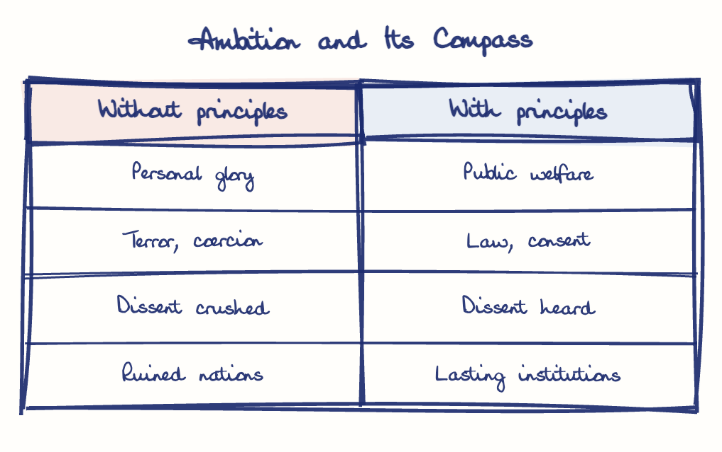
Ambition is morally neutral energy, and the principles guiding it decide whether a ruler harms or builds the nation. Hitler, Stalin and Pol Pot show ambition without principle, while Ashoka, who turned from Kalinga's conquest to Dhamma, shows ambition redeemed by it.
Model answer
Ghissu Editorial · Verified 4 Oct 2026 · 283 words
Ambition as conquest
Hitler's drive for Lebensraum caused the Second World War and the Holocaust, in which about six million Jews were murdered.
Goal licensing any means
Stalin's forced collectivisation brought the famine of 1932-33 in Ukraine, and Pol Pot's agrarian utopia left an estimated 1.5 to 2 million Cambodians dead between 1975 and 1979.
Bold but imprudent
Muhammad bin Tughluq's shift of the capital to Daulatabad (1327) and his token currency, imposed without consultation, ruined his subjects and treasury.
Ambition turned to welfare
Ashoka's edicts record medical care for humans and animals, wells and shade trees along roads.
Ambition with tolerance
Akbar abolished the jizya in 1564 and followed Sulh-i-kul, peace with all, holding a diverse empire together.
Ambition with integrity
Lee Kuan Yew built a prosperous Singapore on meritocracy and a tough anti-corruption law of 1960.
Ambition with forgiveness
Nelson Mandela chose reconciliation over revenge after 1994 through the Truth and Reconciliation Commission.
This model answer is indicative and the model can make mistakes; please verify key facts independently.
Practise this question
1Get the answer sheet
Sized for this question.
2Write your answer
Timed, by hand.
3Get it marked
Your score and what to fix.
This chapter in the exam
Contributions of moral thinkers and philosophers from the world14 questions
Asked in 11 of 14 sittings since 2013
- 2025What do each of these quotations convey to you in the present context? "The greatest discovery of my generation is that a human being can alter his life by altering his attitudes." – William James
- 2022what do each of the following quotations mean to you? "Judge your success by what you had to give up in order to get it." — Dalai Lama
All 14 questions, sorted by sub-topic, with model answers and practice.
Question from the official UPSC Civil Services (Main) Examination 2017 paper. Answer written by Ghissu's engine and checked against our editorial standards. Found an error? Tell us and we correct it within 48 hours.