2018 · GS Paper 1 · Q8 · 10 marks
"Caste system is assuming new identities and associational forms. Hence, caste system cannot be eradicated in India." Comment.
In short
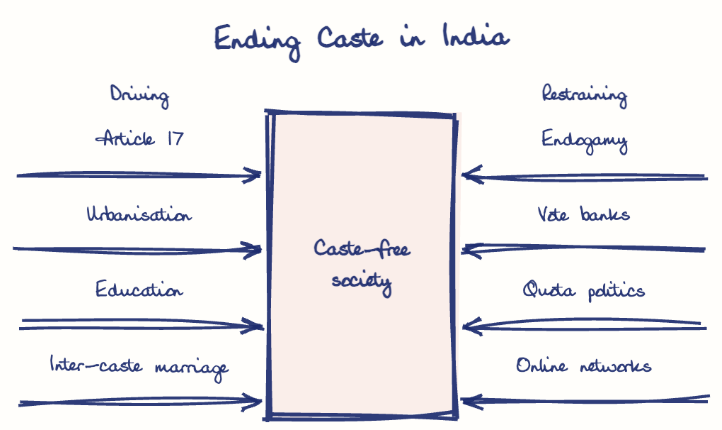
Caste is changing its form, from ritual hierarchy to associations, vote blocs, quota lobbies and online networks, but this shows mutation rather than permanence. Endogamy, with only about 5% of marriages inter-caste per the IHDS, is the hard core that policy must target.
Model answer
Ghissu Editorial · Verified 4 Oct 2026 · 271 words
Caste associations
The Vanniyar Sangam (1980) grew into the PMK in 1989, turning a birth group into a political lobby for jobs and seats, a pattern Rajni Kothari called the politicisation of caste.
Quota assertion
Landed castes seek backward status, as in the Patidar (2015), Jat (2016) and Maratha agitations, the last struck down in Jaishri Laxmanrao Patil (2021).
Digital and diaspora networks
Caste matrimonial portals keep endogamy alive online, and caste travelled abroad, prompting Seattle to ban caste discrimination in 2023.
Hierarchy is weakening
Article 17, the PCR Act (1955) and the SC/ST Atrocities Act (1989) have eroded purity and pollution in public life.
From hierarchy to difference
Dipankar Gupta argues castes now stand as horizontal identities, so identity survives while the ladder weakens.
Endogamy is the hard core
The India Human Development Survey found only about 5% of marriages inter-caste, so caste reproduces itself each generation.
This model answer is indicative and the model can make mistakes; please verify key facts independently.
Practise this question
1Get the answer sheet
Sized for this question.
2Write your answer
Timed, by hand.
3Get it marked
Your score and what to fix.
This chapter in the exam
Salient features of Indian Society, Diversity of India23 questions
Asked in 13 of 14 sittings since 2013
- 2026Unity in diversity remains the defining feature of Indian society despite the challenges from communalism and regionalism. Comment.
- 2026Is caste disappearing in urban India? Illustrate your answer with examples.
All 23 questions, sorted by sub-topic, with model answers and practice.
Question from the official UPSC Civil Services (Main) Examination 2018 paper. Answer written by Ghissu's engine and checked against our editorial standards. Found an error? Tell us and we correct it within 48 hours.