2018 · GS Paper 2 · Q10 · 10 marks
A number of outside powers have entrenched themselves in Central Asia, which is a zone of interest to India. Discuss the implications, in this context, of India's joining the Ashgabat Agreement, 2018.
In short
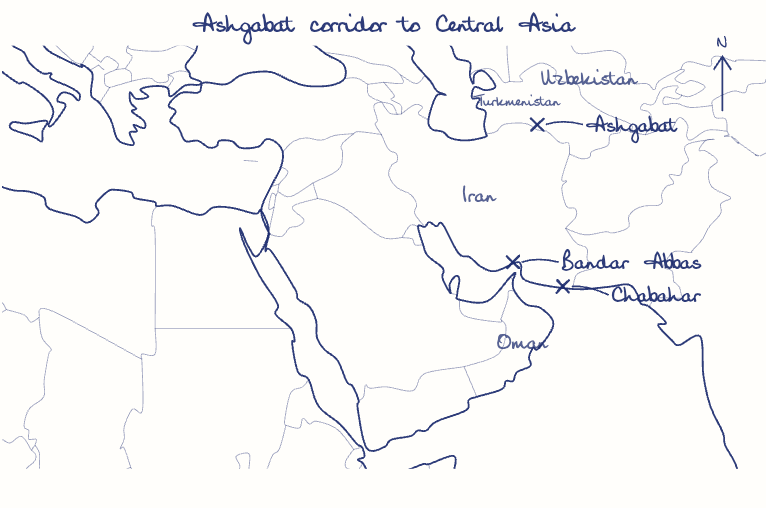
Joining the Ashgabat Agreement in 2018 gave India a multimodal route to Central Asia via Iran that bypasses Pakistan and offers an alternative to Chinese and Russian dominance. Its value depends on linking it with Chabahar and the INSTC, which the 2014 dry run found about 30% cheaper than the Suez route.
Model answer
Ghissu Editorial · Verified 4 Oct 2026 · 272 words
Bypassing Pakistan
It links Chabahar port and the INSTC to Ashgabat's road and rail network, a land bridge to Central Asia beyond Pakistan's transit veto.
Cheaper trade
The 2014 INSTC dry run showed the route could be about 30% cheaper and 40% shorter than the Suez route.
Energy security
Easier access backs the TAPI gas pipeline and Kazakh uranium supplies.
Strategic presence
It gives substance to Connect Central Asia (2012) and India's SCO membership (2017), offering a partner that does not trade loans for leverage.
Iran dependence
The US exit from the Iran nuclear deal in May 2018 and doubts over the Chabahar waiver deter investors.
Missing links
Afghanistan's instability and thin rail capacity keep traffic low.
Unequal scale
India's trade with the region is a fraction of China's, and Pakistan's own accession (2016) makes the pact a shared, not exclusive, platform.
This model answer is indicative and the model can make mistakes; please verify key facts independently.
Practise this question
1Get the answer sheet
Sized for this question.
2Write your answer
Timed, by hand.
3Get it marked
Your score and what to fix.
This chapter in the exam
Regional12 questions
Asked in 10 of 14 sittings since 2013
- 2026“IPMDA (Indo-Pacific Partnership for Maritime Domain Awareness) bridges the gap between India’s SAGAR (Security and Growth for All in the Region) vision and the Quad’s collective Indo-Pacific strategy.” Make a critical assessment of the statement focusing on IPMDA.
- 2025"Energy security constitutes the dominant kingpin of India's foreign policy, and is linked with India's overarching influence in Middle Eastern countries." How would you integrate energy security with India's foreign policy trajectories in the coming years?
All 12 questions, sorted by sub-topic, with model answers and practice.
Question from the official UPSC Civil Services (Main) Examination 2018 paper. Answer written by Ghissu's engine and checked against our editorial standards. Found an error? Tell us and we correct it within 48 hours.