2018 · GS Paper 2 · Q13 · 15 marks
Indian and USA are two large democracies. Examine the basic tenets on which the two political systems are based.
In short
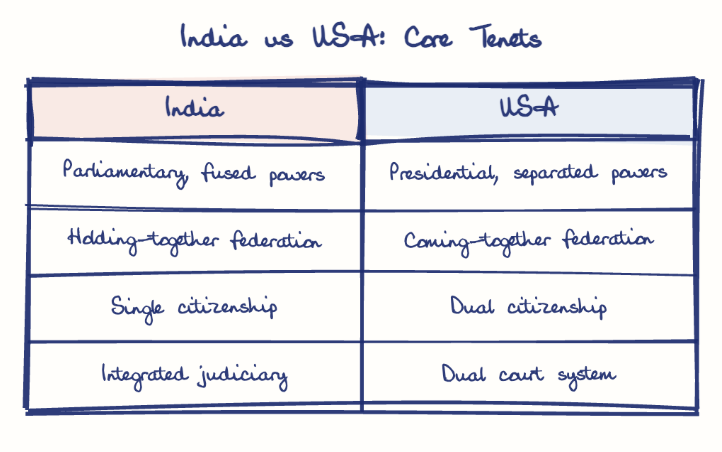
India and the USA share popular sovereignty, a supreme written Constitution, fundamental rights and judicial review, but India built a parliamentary, centripetal federation while the USA built a presidential system with separated powers. India's ministers answer to the Lok Sabha under Article 75(3), whereas the US President serves a fixed term.
Model answer
Ghissu Editorial · Verified 4 Oct 2026 · 304 words
Popular sovereignty
Both have elected heads of State and universal franchise, in India from 1950 under Article 326.
Constitutional supremacy
Judicial review, born in Marbury v. Madison (1803), is part of India's basic structure (Minerva Mills, 1980).
Rights and federalism
The Bill of Rights and Part III protect liberty, and both divide power between Centre and states.
Executive accountability
India's ministers answer collectively to the Lok Sabha under Article 75(3); the US President's fixed term buys stability at the risk of gridlock, as the 35-day shutdown of 2018-19 showed.
Nature of the Union
Article 3 lets Parliament reshape States and Article 248 gives it residuary powers, while Texas v. White (1869) made American states indestructible and the Tenth Amendment reserves residuary powers to them.
Amendment limits
India's flexible Article 368 is bounded by Kesavananda Bharati (1973); Article V's rigidity has allowed only 27 US amendments.
Mutual learning
India can borrow Congressional-style committee scrutiny of Bills and act on the Punchhi Commission's (2010) proposals on Governors and the Inter-State Council.
This model answer is indicative and the model can make mistakes; please verify key facts independently.
Practise this question
1Get the answer sheet
Sized for this question.
2Write your answer
Timed, by hand.
3Get it marked
Your score and what to fix.
This chapter in the exam
Comparison of the Indian Constitutional Scheme with That of Other Countries8 questions
Asked in 7 of 14 sittings since 2013
- 2026Examine how the separation of powers is practised in India compared to the rigid presidential model of the United States of America. In this context, compare the actual authority of the Indian Prime Minister with that of the President of the USA.
- 2025Compare and contrast the President's power to pardon in India and in the USA. Are there any limits to it in both the countries? What are preemptive pardons?
All 8 questions, sorted by sub-topic, with model answers and practice.
Question from the official UPSC Civil Services (Main) Examination 2018 paper. Answer written by Ghissu's engine and checked against our editorial standards. Found an error? Tell us and we correct it within 48 hours.