2018 · GS Paper 3 · Q4 · 10 marks
Examine the role of supermarkets in supply chain management of fruits, vegetables and food items. How do they eliminate number of intermediaries?
In short
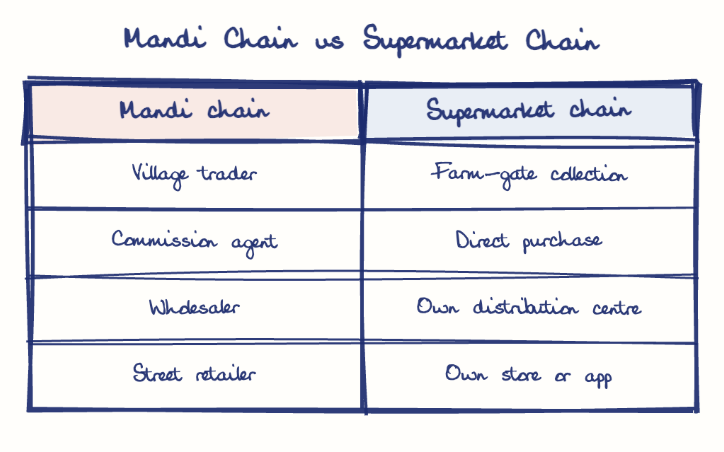
Supermarkets organise procurement, cold storage, grading and retail for fruits, vegetables and food items, cutting wastage and improving quality. They remove intermediaries by buying directly at farm-gate collection centres or from FPOs, a shift enabled by reforms like Maharashtra's 2016 delisting of fruits and vegetables from APMC control.
Model answer
Ghissu Editorial · Verified 4 Oct 2026 · 297 words
Organised procurement
Reliance Retail and Mother Dairy's Safal buy through collection centres or grower associations and grade produce at source.
Less wastage
Distribution centres, ripening chambers and reefer transport cut perishable losses, valued at about ₹1.53 lakh crore a year (NABCONS, 2022).
Quality and limits
Grading, packaging and FSSAI labelling give consumers safe, consistent food, though strict rejection norms and delayed payments can squeeze small growers.
Buying outside the mandi
The Model APLM Act, 2017 and Maharashtra's 2016 delisting of fruits and vegetables let chains buy directly, removing commission agents.
Vertical integration
Owning warehouses, transport and stores lets one firm do the work of the wholesaler and sub-wholesaler, removing each handling margin.
FPO linkages
Sahyadri Farms in Nashik supplies grapes and vegetables straight to retail chains, replacing the village aggregator.
Back-end rule
The multi-brand retail FDI policy (2012, revised in 2013) requires half of the first USD 100 million to go into back-end infrastructure.
This model answer is indicative and the model can make mistakes; please verify key facts independently.
Practise this question
1Get the answer sheet
Sized for this question.
2Write your answer
Timed, by hand.
3Get it marked
Your score and what to fix.
This chapter in the exam
Food Processing and Related Industries7 questions
Asked in 7 of 14 sittings since 2013
- 2025Examine the scope of the food processing industries in India. Elaborate the measures taken by the government in the food processing industries for generating employment opportunities.
- 2022Elaborate the scope and significance of the food processing industry in India.
All 7 questions, sorted by sub-topic, with model answers and practice.
Question from the official UPSC Civil Services (Main) Examination 2018 paper. Answer written by Ghissu's engine and checked against our editorial standards. Found an error? Tell us and we correct it within 48 hours.