2018 · GS Paper 3 · Q9 · 10 marks
The China-Pakistan Economic Corridor (CPEC) is viewed as a cardinal subset of China's larger 'One Belt One Road' initiative. Give a brief description of CPEC and enumerate the reasons why India has distanced itself from the same.
In short
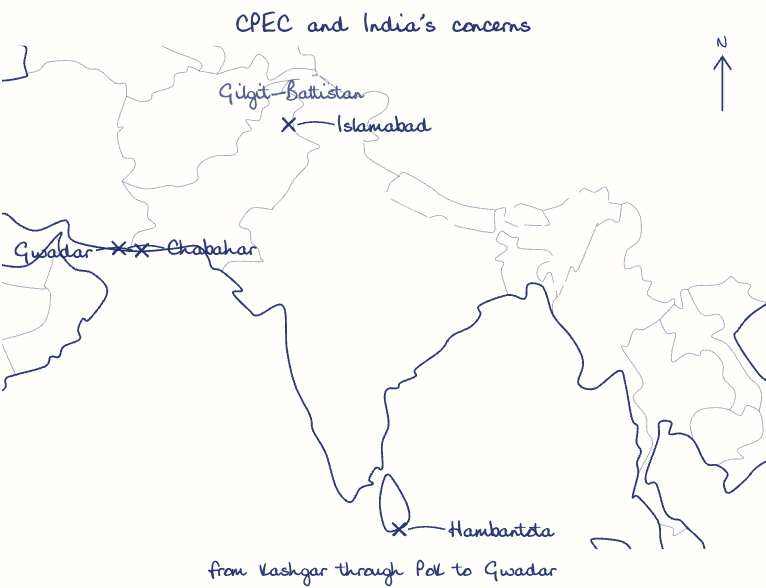
CPEC is a roughly 3,000 km corridor of roads, rail, pipelines and power projects linking Kashgar to Gwadar, and India stays away because it violates Indian sovereignty and aids China's strategic encirclement. The corridor runs through Gilgit-Baltistan in Pakistan-occupied Kashmir, which India claims as its own.
Model answer
Ghissu Editorial · Verified 4 Oct 2026 · 280 words
When China held its first Belt and Road Forum in May 2017, India stayed away, objecting chiefly to the China-Pakistan Economic Corridor (CPEC), the flagship of the Belt and Road Initiative announced in 2013.
CPEC in Brief
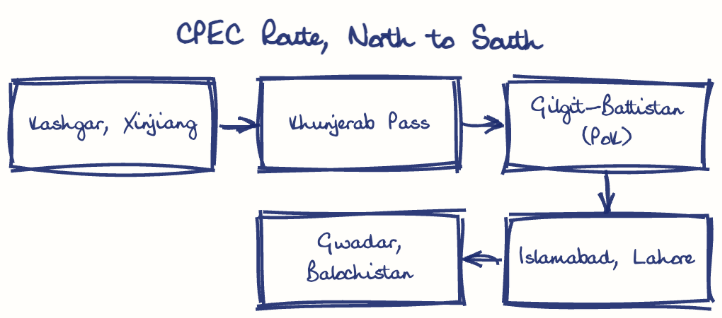
CPEC Route, North to South → Kashgar, Xinjiang → Khunjerab Pass → Gilgit-Baltistan (PoK) → Islamabad, Lahore → Gwadar, Balochistan
1. Route and scale: Roughly 3,000 km of roads, rail and pipelines link Kashgar in Xinjiang to Gwadar in Balochistan; launched in April 2015 with about 46 billion dollars of projects, it is now valued at over 60 billion dollars. 2. Components: Power plants form the largest share, alongside the Karakoram Highway upgrade, the Gwadar port and special economic zones. 3. Purpose for China: It offers an overland route to the Arabian Sea and a hedge against the Malacca Dilemma.
Sovereignty
It passes through Gilgit-Baltistan, Indian territory under Pakistan's illegal occupation, and the Ministry of External Affairs said in 2017 that no country can accept a project ignoring its core concerns on sovereignty.
Strategic encirclement
Gwadar, near the Strait of Hormuz, adds to the String of Pearls and could host China's navy.
Collusive threat
Deeper China-Pakistan ties raise the risk of a two-front challenge, seen when China blocked Masood Azhar's UN listing until 2019.
Debt and opacity
Sri Lanka's 99-year lease of Hambantota to a Chinese firm in 2017 showed how opaque loans erode autonomy.
This model answer is indicative and the model can make mistakes; please verify key facts independently.
Practise this question
1Get the answer sheet
Sized for this question.
2Write your answer
Timed, by hand.
3Get it marked
Your score and what to fix.
This chapter in the exam
External State Actors2 questions
Asked in 2 of 14 sittings since 2013
Question from the official UPSC Civil Services (Main) Examination 2018 paper. Answer written by Ghissu's engine and checked against our editorial standards. Found an error? Tell us and we correct it within 48 hours.