2018 · GS Paper 4 · Q12 · 20 marks
Edward Snowden, a computer expert and former CIA systems administrator, released confidential Government documents to the press about the existence of Government surveillance programmes. According to many legal experts and the US Government, his actions violated the Espionage Act of 1917, which identified the leak of State secrets as an act of treason. Yet, despite the fact that he broke the law, Snowden argued that he had a moral obligation to act. He gave a justification for his "whistle blowing" by stating that he had a duty "to inform the public as to that which is done in their name and that which is done against them." According to Snowden, the Government's violation of privacy had to be exposed regardless of legality since more substantive issues of social action and public morality were involved here. Many agreed with Snowden. Few argued that he broke the law and compromised national security, for which he should be held accountable. Do you agree that Snowden's actions were ethically justified even if legally prohibited? Why or why not? Make an argument by weighing the competing values in this case.
In short
Snowden's exposure of NSA bulk phone-records collection was ethically justified despite breaking the law, but only partly, since the scale of the leak and his flight from accountability fail proportionality. In ACLU v Clapper (2015) a US appeals court held the bulk programme exceeded the Patriot Act.
Model answer
Ghissu Editorial · Verified 4 Oct 2026 · 278 words
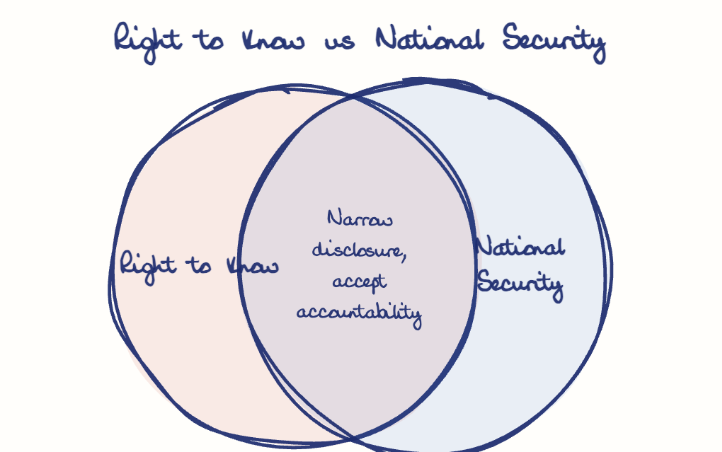
Privacy vs National Security
Both protect citizens, one from the State and one from external threats.
Conscience vs Rule of Law
Moral judgement clashes with the Espionage Act of 1917, under which he was charged.
A real wrong
In ACLU v Clapper (2015) [case] a US appeals court held bulk collection exceeded the Patriot Act, and the USA FREEDOM Act, 2015 ended it.
Failed channels
A secret court approved the programme, and whistleblower protections then excluded contractors.
Persons as ends
Kant's principle supports the citizen's right to know how the State watches him.
Indiscriminate scale
Releasing foreign-intelligence material fails Proportionality.
Evading accountability
Gandhi in 1922 and Ellsberg after the Pentagon Papers (1971) [case] faced trial; Snowden fled.
This model answer is indicative and the model can make mistakes; please verify key facts independently.
Practise this question
1Get the answer sheet
Sized for this question.
2Write your answer
Timed, by hand.
3Get it marked
Your score and what to fix.
This chapter in the exam
Emerging Domain Dilemmas4 questions
Asked in 3 of 14 sittings since 2013
- 2024There is a technological company named ABC Incorporated which is the second largest worldwide, situated in the Third World. You are the Chief Executive Officer and the majority shareholder of this company. The fast technological improvements have raised worries among environmental activists, regulatory authorities, and the general public over the sustainability of this scenario. You confront substantial issues about the business's environmental footprint. In 2023, your organization had a significant increase of 48% in greenhouse gas emissions compared to the levels recorded in 2019. The significant rise in energy consumption is mainly due to the surging energy requirements of your data centers, fuelled by the exponential expansion of Artificial Intelligence (AI). AI-powered services need much more computational resources and electrical energy compared to conventional online activities, notwithstanding their notable gains. The technology's proliferation has led to a growing concern over the environmental repercussions, resulting in an increase in warnings. AI models, especially those used in extensive machine learning and data processing, exhibit much greater energy consumption than conventional computer tasks, with an exponential increase. Although there is already a commitment and goal to achieve net zero emissions by 2030, the challenge of lowering emissions seems overwhelming as the integration of AI continues to increase. To achieve this goal, substantial investments in renewable energy use would be necessary. The difficulty is exacerbated by the competitive environment of the technology sector, where rapid innovation is essential for preserving market standing and shareholders' worth. To achieve a balance between innovation, profitability and sustainability, a strategic move is necessary that is in line with both, business objectives and ethical obligations. (a) What is your immediate response to the challenges posed in the above case? (b) Discuss the ethical issues involved in the above case. (c) Your company has been identified to be penalized by technological giants. What logical and ethical arguments will you put forth to convince about its necessity? (d) Being a conscience being, what measures would you adopt to maintain balance between AI innovation and environmental footprint?
- 2024Dr. Srinivasan is a senior scientist working for a reputed biotechnology company known for its cutting-edge research in pharmaceuticals. Dr. Srinivasan is heading a research team working on a new drug aimed at treating a rapidly spreading variant of a new viral infectious disease. The disease has been rapidly spreading across the world and the cases reported in the country are increasing. There is huge pressure on Dr. Srinivasan's team to expedite the trials for the drug as there is significant market for it, and the company wants to get the first-mover advantage in the market. During a team meeting, some senior team members suggest some shortcut for expediting the clinical trials for the drug and for getting the requisite approvals. These include manipulating data to exclude some negative outcomes and selectively reporting positive results, foregoing the process of informed consent and using compounds already patented by a rival company, rather than developing one's own component. Dr. Srinivasan is not comfortable taking such shortcuts, at the same time he realises meeting the targets is impossible without using these means. (a) What would you do in such a situation? (b) Examine your options and consequences in the light of the ethical questions involved. (c) How can data ethics and drug ethics save humanity at large in such a scenario?
All 4 questions, sorted by sub-topic, with model answers and practice.
Question from the official UPSC Civil Services (Main) Examination 2018 paper. Answer written by Ghissu's engine and checked against our editorial standards. Found an error? Tell us and we correct it within 48 hours.