2019 · GS Paper 1 · Q19 · 15 marks
What are the continued challenges for women in India against time and space ?
In short
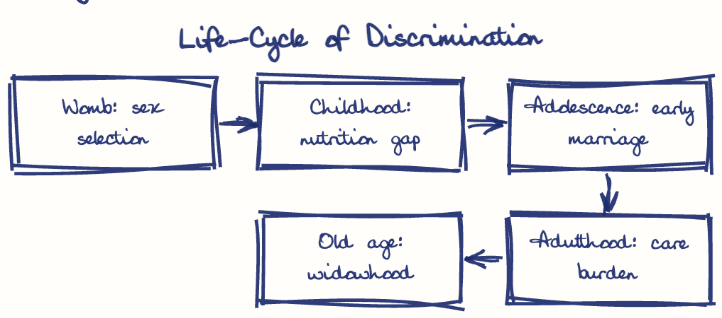
Indian women face barriers that persist across their life cycle, from sex selection and child marriage to care burdens and widowhood, and across the home, public, digital and political spaces. NFHS-5 still records a sex ratio at birth of 929 despite the PCPNDT Act.
Model answer
Ghissu Editorial · Verified 4 Oct 2026 · 269 words
Before birth
Son preference keeps the sex ratio at birth at 929 (NFHS-5) despite the PCPNDT Act, 1994.
Girlhood
About 23% of women aged 20-24 married before 18 (NFHS-5), ending schooling early.
Care burden
The Time Use Survey 2024 shows women's paid-work time rose by only six minutes since 2019, as unpaid care still falls on them.
The home
About 29% of ever-married women reported spousal violence (NFHS-5), and patrilocal marriage cuts brides off from natal support.
Public space and work
Fear of harassment limits mobility, and the POSH Act, 2013 is weak in informal workplaces.
Digital space
Women are 30% less likely than men to use mobile internet (GSMA, 2024) and face trolling and deepfakes online.
Regional and political space
The child sex ratio was 834 in Haryana but 964 in Kerala (Census 2011), and women hold only 74 Lok Sabha seats (2024).
Norms and care
Gender-sensitive schooling, creches and safe-by-design public spaces must be funded and audited.
This model answer is indicative and the model can make mistakes; please verify key facts independently.
Practise this question
1Get the answer sheet
Sized for this question.
2Write your answer
Timed, by hand.
3Get it marked
Your score and what to fix.
This chapter in the exam
Role of women and women's organization13 questions
Asked in 8 of 14 sittings since 2013
- 2024Distinguish between gender equality, gender equity and women's empowerment. Why is it important to take gender concerns into account in programme design and implementation?
- 2024Globalization has increased urban migration by skilled, young, unmarried women from various classes. How has this trend impacted upon their personal freedom and relationship with family?
All 13 questions, sorted by sub-topic, with model answers and practice.
Question from the official UPSC Civil Services (Main) Examination 2019 paper. Answer written by Ghissu's engine and checked against our editorial standards. Found an error? Tell us and we correct it within 48 hours.