2019 · GS Paper 3 · Q14 · 15 marks
Elaborate the policy taken by the Government of India to meet the challenges of the food processing sector.
In short
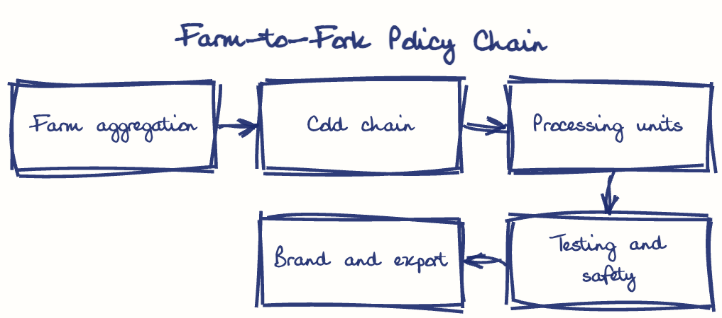
Government policy meets the food processing sector's challenges link by link: PM Kisan SAMPADA and Operation Greens for infrastructure, PLI and PMFME for scale and micro units, FDI and FSSAI for capital and quality. Yet only 42% of the ₹2,000 crore Special Food Processing Fund was disbursed by March 2025.
Model answer
Ghissu Editorial · Verified 4 Oct 2026 · 293 words
PM Kisan SAMPADA (2017)
It funds Mega Food Parks, cold chains and agro-processing clusters, and 1,608 projects were sanctioned by February 2025.
Cold chain
To cut perishable wastage, 291 of 395 approved cold-chain projects were running by June 2025 with 25.52 lakh tonnes of capacity.
Operation Greens (2018)
It funds storage and processing to steady tomato, onion and potato prices, and was extended to all fruits and vegetables in 2020.
PLI scheme (2021)
An outlay of ₹10,900 crore over six years rewards sales growth of Indian food brands, with a separate millet PLI.
PMFME (2020)
It backs micro units through One District One Product clusters and a 35% credit-linked subsidy, with 1,44,517 loans sanctioned (PIB, 2025).
Capital and regulation
Manufacturing allows 100% automatic-route FDI, a ₹2,000 crore NABARD fund offers cheaper loans, and FSSAI's 2026 reforms raise the registration threshold to ₹1.5 crore.
Faster spending
Only 42% of the Special Food Processing Fund was disbursed by March 2025 (Standing Committee, 2025), so time-bound release must come first.
Clusters and standards
Link ODOP clusters with FPOs and e-NAM, and align FSSAI norms with Codex for exports.
This model answer is indicative and the model can make mistakes; please verify key facts independently.
Practise this question
1Get the answer sheet
Sized for this question.
2Write your answer
Timed, by hand.
3Get it marked
Your score and what to fix.
This chapter in the exam
Food Processing and Related Industries7 questions
Asked in 7 of 14 sittings since 2013
- 2025Examine the scope of the food processing industries in India. Elaborate the measures taken by the government in the food processing industries for generating employment opportunities.
- 2022Elaborate the scope and significance of the food processing industry in India.
All 7 questions, sorted by sub-topic, with model answers and practice.
Question from the official UPSC Civil Services (Main) Examination 2019 paper. Answer written by Ghissu's engine and checked against our editorial standards. Found an error? Tell us and we correct it within 48 hours.