2019 · GS Paper 3 · Q19 · 15 marks
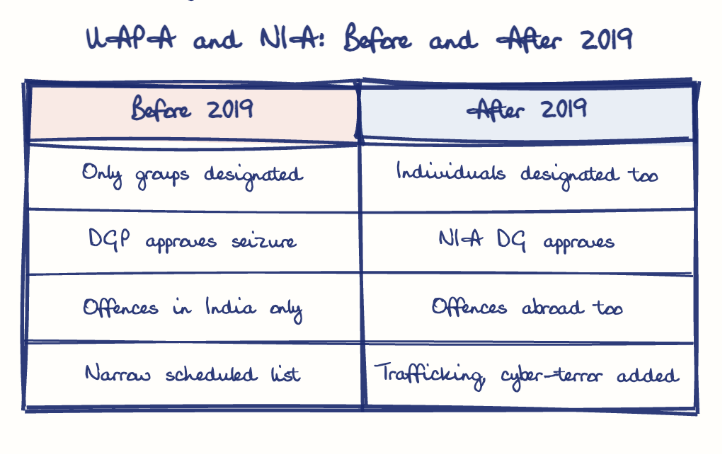
Indian Government has recently strengthened the anti-terrorism laws by amending the Unlawful Activities (Prevention) Act (UAPA), 1967 and the NIA Act. Analyze the changes in the context of prevailing security environment while discussing the scope and reasons for opposing the UAPA by human rights organizations.
In short
The 2019 UAPA and NIA amendments let the state designate individual terrorists, probe offences abroad and cover hybrid threats, but rights groups oppose executive designation, vague definitions and near-impossible bail. Between 2016 and 2019, 5,922 people were arrested under UAPA but only 132 convicted.
Model answer
Ghissu Editorial · Verified 4 Oct 2026 · 299 words
Targeting individuals
Outfits resurface under new names, so naming individuals such as Masood Azhar and Hafiz Saeed (September 2019) closes the gap.
Reach across borders
The Sri Lanka Easter bombings (2019) showed why the NIA needs power to probe crimes against Indians abroad.
Hybrid threats
Adding trafficking, counterfeit currency and cyber-terrorism tracks how terror is now financed and waged through crime and cyberspace, and Inspector-rank NIA officers can now investigate.
No due process
Executive designation without a hearing weakens the presumption of innocence under Article 21.
Vague definitions
"Likely to threaten" and membership offences, upheld when Arup Bhuyan was overruled in 2023, cast a wide net.
Process as punishment
After Watali (2019), bail is near impossible; 2016-2019 saw 5,922 arrests but 132 convictions, and Stan Swamy died in custody in 2021.
Dissent and federalism
Cases against journalists and Chhattisgarh's 2020 Article 131 suit show fears of misuse and central overreach.
Judicial safeguards
Provide judicial review of every listing, speedy trials in NIA special courts and bail for delay under K.A. Najeeb (2021).
This model answer is indicative and the model can make mistakes; please verify key facts independently.
Practise this question
1Get the answer sheet
Sized for this question.
2Write your answer
Timed, by hand.
3Get it marked
Your score and what to fix.
This chapter in the exam
Extremism17 questions
Asked in 11 of 14 sittings since 2013
- 2026Separatist movements have been one of the major factors contributing to militancy and instability in Jammu & Kashmir (J&K). Bring out actions taken by the Government to bring J&K into national mainstream. Discuss pre and post abrogation status of Articles 370 and 35A. Also bring out positive impacts of abrogation of both articles in mainstreaming the state. (Answer in 250 words)
- 2025The Government of India recently stated that Left Wing Extremism (LWE) will be eliminated by 2026. What do you understand by LWE and how are the people affected by it ? What measures have been taken by the government to eliminate LWE ?
All 17 questions, sorted by sub-topic, with model answers and practice.
Question from the official UPSC Civil Services (Main) Examination 2019 paper. Answer written by Ghissu's engine and checked against our editorial standards. Found an error? Tell us and we correct it within 48 hours.