2019 · GS Paper 3 · Q12 · 15 marks
The public expenditure management is a challenge to the Government of India in the context of budget making during the post-liberalization period. Clarify it.
In short
Post-1991 budget making must fund growth and welfare within deficit limits, but committed spending, subsidy shocks, off-budget borrowing and weak scrutiny make expenditure management hard. Capital expenditure rose from 1.5% of GDP in 2017-18 to a budgeted 3.1% in 2026-27, improving spending quality.
Model answer
Ghissu Editorial · Verified 4 Oct 2026 · 289 words
Committed spending
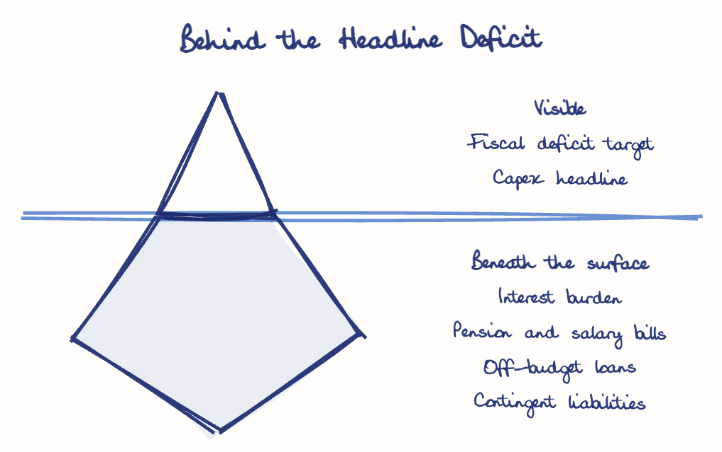
Interest, salaries, pensions and subsidies pre-empt most revenue, interest alone taking roughly a quarter of Union spending.
Fiscal rules versus needs
Under the FRBM Act, 2003 and the N.K. Singh Committee's debt anchors (2017), capital spending was cut first in lean years because it is easiest to defer.
Subsidy and populism pressures
Food, fertiliser and fuel subsidies swing with global prices, and pay commission awards add permanent obligations.
Off-budget opacity
NSSF loans to FCI hid food subsidy until the 2021-22 Budget brought it on the books.
Capex shift
Capital expenditure rose from 1.5% of GDP in 2017-18 to a budgeted 3.1% in 2026-27.
Process reforms
Merging plan and non-plan spending in 2017 and the Output-Outcome Framework shifted focus to results.
Weak execution and scrutiny
The CAG found Rs 1.96 lakh crore unspent in 2022-23, and about 80% of the budget passed without discussion in 2019-23 (PRS).
Outcomes and transparency
Link allocations to outcomes evaluated by NITI Aayog's DMEO, expand DBT, and disclose all off-budget borrowings.
Parliamentary scrutiny
Strengthen departmental committees so fewer demands are guillotined.
This model answer is indicative and the model can make mistakes; please verify key facts independently.
Practise this question
1Get the answer sheet
Sized for this question.
2Write your answer
Timed, by hand.
3Get it marked
Your score and what to fix.
This chapter in the exam
Public Expenditure & Subsidies1 question
Asked in 1 of 14 sittings since 2013
Question from the official UPSC Civil Services (Main) Examination 2019 paper. Answer written by Ghissu's engine and checked against our editorial standards. Found an error? Tell us and we correct it within 48 hours.