2020 · GS Paper 1 · Q19 · 15 marks
Customs and traditions suppress reason leading to obscurantism. Do you agree ?
In short
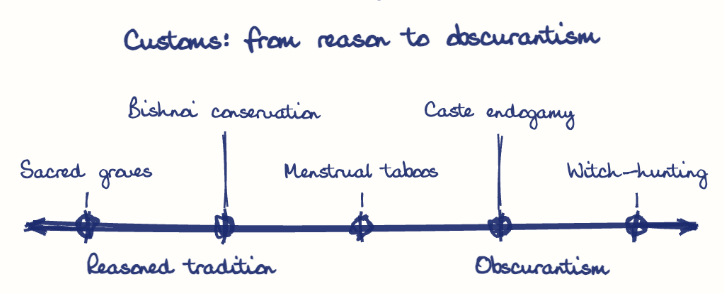
Customs and traditions suppress reason only when they harden into unquestioned dogma, as witch-hunting, honour killings and menstrual taboos show, while many encode ecological wisdom and India's tradition of argument. Article 51A(h) on scientific temper offers the test for keeping their wisdom and discarding their obscurantism.
Model answer
Ghissu Editorial · Verified 4 Oct 2026 · 279 words
Superstition over evidence
Witch-hunting in Jharkhand and the Elanthoor human sacrifice in Kerala (2022) show belief overriding reason and law.
Hierarchy and gender control
Untouchability and honour killings are defended as custom, and menstrual and triple talaq practices survived until Indian Young Lawyers Association (2018) and Shayara Bano (2017).
Resistance to change
NFHS-5 (2019-21) found 23.3% of women aged 20-24 married before 18, despite a 2006 law.
Ecological wisdom
Sacred groves like Mawphlang in Meghalaya, the Bishnoi sacrifice at Khejarli (1730) and stepwell water harvesting encode sound conservation logic, while festivals give communities cohesion.
A tradition of argument
The Kalama Sutta, Nyaya logic and Akbar's Ibadat Khana reflect what Amartya Sen calls "The Argumentative Indian", and reformers like Ram Mohan Roy and Phule reformed from within.
Scientific temper and law
Schools should build inquiry-based learning as NEP 2020 intends, and states should enforce anti-superstition laws like Karnataka's (2017).
Reform from within
Engage religious leaders, panchayats and women's groups, while courts test customs against dignity and equality.
This model answer is indicative and the model can make mistakes; please verify key facts independently.
Practise this question
1Get the answer sheet
Sized for this question.
2Write your answer
Timed, by hand.
3Get it marked
Your score and what to fix.
This chapter in the exam
Salient features of Indian Society, Diversity of India23 questions
Asked in 13 of 14 sittings since 2013
- 2026Unity in diversity remains the defining feature of Indian society despite the challenges from communalism and regionalism. Comment.
- 2026Is caste disappearing in urban India? Illustrate your answer with examples.
All 23 questions, sorted by sub-topic, with model answers and practice.
Question from the official UPSC Civil Services (Main) Examination 2020 paper. Answer written by Ghissu's engine and checked against our editorial standards. Found an error? Tell us and we correct it within 48 hours.