2020 · GS Paper 1 · Q18 · 15 marks
Is diversity and pluralism in India under threat due to globalisation ? Justify your answer.
In short
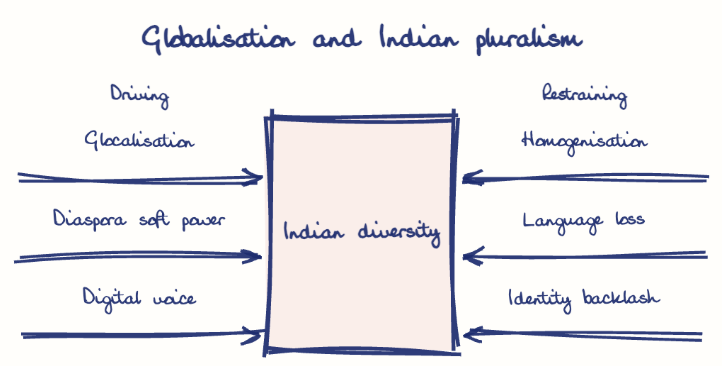
Globalisation strains India's diversity at the edges through cultural homogenisation, language loss and identity backlash, but it does not threaten pluralism at its core and also takes regional cultures global. The People's Linguistic Survey of India (2013) estimated about 220 languages died in fifty years.
Model answer
Ghissu Editorial · Verified 4 Oct 2026 · 294 words
Homogenisation
Global consumer culture spreads uniform tastes in food, dress and entertainment across regions.
Language and craft loss
The People's Linguistic Survey of India (2013) estimated about 220 languages lost in fifty years, while English and factory goods squeeze small languages and handlooms.
Identity backlash
Giddens saw globalisation provoking defensive identities, as in Haryana's 75% local jobs law (2020), struck down in 2023.
Glocalisation
McDonald's dropping beef and pork from its Indian menus shows local culture reshaping the global, what Roland Robertson called glocalisation.
Regional cultures go global
"Naatu Naatu" won the Oscar (2023) and UNESCO inscribed Garba (2023), while the diaspora and the International Day of Yoga turn tradition into soft power.
Digital voice
The internet lets Dalit, Adivasi and small-language communities publish and organise, and Bhashini (2022) builds AI translation across Indian languages.
Language and livelihood
Mother-tongue schooling under NEP 2020 can slow language loss, while GI tags and One District One Product can carry crafts to global markets.
Fraternity
Ek Bharat Shreshtha Bharat exchanges and media literacy can keep identity anxiety from turning into polarisation.
This model answer is indicative and the model can make mistakes; please verify key facts independently.
Practise this question
1Get the answer sheet
Sized for this question.
2Write your answer
Timed, by hand.
3Get it marked
Your score and what to fix.
This chapter in the exam
Salient features of Indian Society, Diversity of India23 questions
Asked in 13 of 14 sittings since 2013
- 2026Unity in diversity remains the defining feature of Indian society despite the challenges from communalism and regionalism. Comment.
- 2026Is caste disappearing in urban India? Illustrate your answer with examples.
All 23 questions, sorted by sub-topic, with model answers and practice.
Question from the official UPSC Civil Services (Main) Examination 2020 paper. Answer written by Ghissu's engine and checked against our editorial standards. Found an error? Tell us and we correct it within 48 hours.