2020 · GS Paper 2 · Q4 · 10 marks
The judicial systems in India and UK seem to be converging as well as diverging in the recent times. Highlight the key points of convergence and divergence between the two nations in terms of their judicial practices.
In short
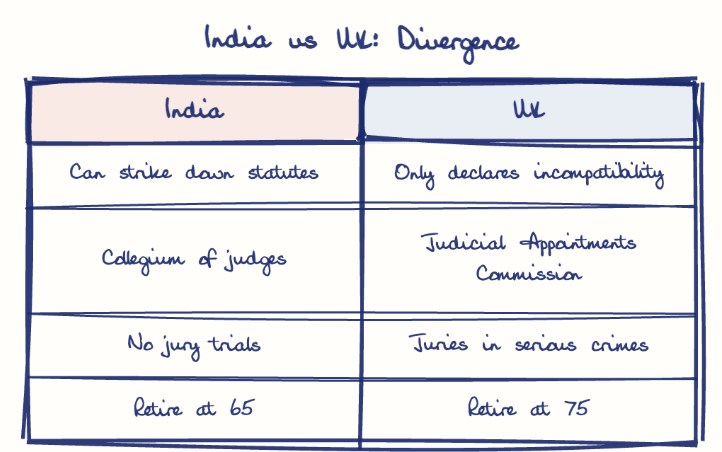
Indian and UK judiciaries are converging through a separate UK Supreme Court since 2009, rights-based proportionality review and open hearings, but diverge because only Indian courts can strike down statutes. Miller (No. 2) in 2019 showed convergence, while India's collegium and PIL mark divergence.
Model answer
Ghissu Editorial · Verified 4 Oct 2026 · 300 words
Separate apex court
The Constitutional Reform Act 2005 created a UK Supreme Court (2009) outside the House of Lords, like India's Article 124 court.
Review of executive power
Miller (No. 2), 2019, held the five-week prorogation of Parliament unlawful, echoing India's scrutiny of political power in S.R. Bommai (1994).
Rights-based review
The Human Rights Act 1998 lets UK courts test laws against rights, and India's proportionality test in Puttaswamy (2017) brings similar structured scrutiny of State action.
Open justice
The UK Supreme Court streams its hearings, and India has live-streamed Constitution Bench hearings since 2022 after Swapnil Tripathi (2018).
Judicial law-making
The Vishaka (1997) guidelines on workplace harassment filled a legislative gap, a role UK judges avoid out of deference to Parliament, and Indian courts can even void constitutional amendments.
Access and standing
Public interest litigation and suo motu cases, such as the 2021 pandemic oxygen case, relax standing far beyond the UK's "sufficient interest" test.
This model answer is indicative and the model can make mistakes; please verify key facts independently.
Practise this question
1Get the answer sheet
Sized for this question.
2Write your answer
Timed, by hand.
3Get it marked
Your score and what to fix.
This chapter in the exam
Comparison of the Indian Constitutional Scheme with That of Other Countries8 questions
Asked in 7 of 14 sittings since 2013
- 2026Examine how the separation of powers is practised in India compared to the rigid presidential model of the United States of America. In this context, compare the actual authority of the Indian Prime Minister with that of the President of the USA.
- 2025Compare and contrast the President's power to pardon in India and in the USA. Are there any limits to it in both the countries? What are preemptive pardons?
All 8 questions, sorted by sub-topic, with model answers and practice.
Question from the official UPSC Civil Services (Main) Examination 2020 paper. Answer written by Ghissu's engine and checked against our editorial standards. Found an error? Tell us and we correct it within 48 hours.