2020 · GS Paper 3 · Q4 · 10 marks
What are the challenges and opportunities of food processing sector in the country? How can income of the farmers be substantially increased by encouraging food processing?
In short
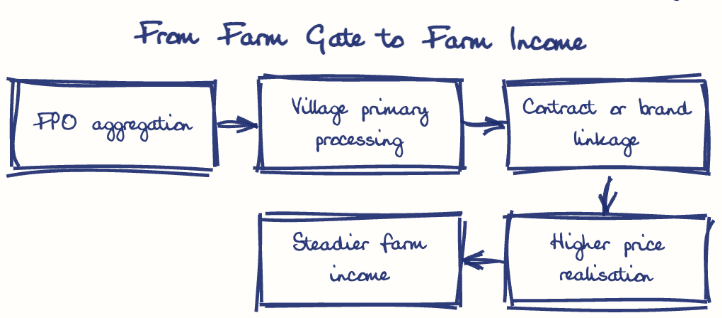
Food processing faces fragmented supply, thin cold chains and informality, but urban demand, exports and PLI support offer large opportunities. It raises farm income when value is added near the farm and shared, as Amul does, since farmers now get only about a third of tomato and onion retail prices.
Model answer
Ghissu Editorial · Verified 4 Oct 2026 · 282 words
Supply and finance gaps
Small holdings give uneven raw material, cold chains are thin, and only 42% of the ₹2,000 crore Special Food Processing Fund was disbursed by March 2025 (Standing Committee, 2025).
Informality
Unregistered units employ 4.68 million workers against 2.23 million in registered ones (PIB, 2025).
Rising demand and policy push
Urban diets and exports, where processed food is 20.4% of USD 49.4 billion agri-food exports (2024-25), are backed by the ₹10,900 crore PLI scheme (2021).
Bigger value share
Farmers get only about a third of the retail price of tomatoes, onions and potatoes (RBI, 2024), while Amul's farmer-owned model returns most of the consumer price of milk to members.
Fewer distress sales
Operation Greens (2018, widened in 2020) funds storage and processing to absorb gluts.
Village enterprise
PMFME has sanctioned 1,44,517 loans and seed capital for 1,03,201 SHG members (PIB, 2025), adding off-farm income.
Assured demand
Contract buy-back, as with PepsiCo's potato growers in Punjab, and the 10,000 FPOs scheme let farmers grow higher-value crops.
This model answer is indicative and the model can make mistakes; please verify key facts independently.
Practise this question
1Get the answer sheet
Sized for this question.
2Write your answer
Timed, by hand.
3Get it marked
Your score and what to fix.
This chapter in the exam
Food Processing and Related Industries7 questions
Asked in 7 of 14 sittings since 2013
- 2025Examine the scope of the food processing industries in India. Elaborate the measures taken by the government in the food processing industries for generating employment opportunities.
- 2022Elaborate the scope and significance of the food processing industry in India.
All 7 questions, sorted by sub-topic, with model answers and practice.
Question from the official UPSC Civil Services (Main) Examination 2020 paper. Answer written by Ghissu's engine and checked against our editorial standards. Found an error? Tell us and we correct it within 48 hours.