2021 · GS Paper 2 · Q13 · 15 marks
Analyze the distinguishing features of the notion of Equality in the Constitutions of the USA and India.
In short
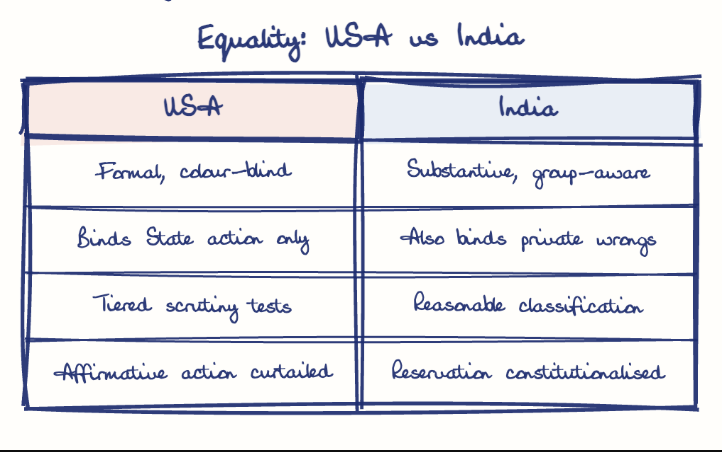
American equality, added by the 14th Amendment, is formal and individual and binds only State action, while India's Articles 14 to 18 pursue substantive equality that also reaches private discrimination. India treats reservation as a facet of equality (Indra Sawhney, 1992), whereas SFFA v. Harvard (2023) ended race-conscious US admissions.
Model answer
Ghissu Editorial · Verified 4 Oct 2026 · 299 words
Textual origin
The 1787 US Constitution had no equality clause; it came with the 14th Amendment (1868), whereas India built it into the original text and Preamble.
Double formula
Article 14 joins British equality before the law to American equal protection, for every person.
Private reach
The US clause binds only the State, needing the Civil Rights Act of 1964, while India's Articles 17 and 15(2) bind private persons too.
Testing laws
The US uses tiered scrutiny; India uses reasonable classification (Anwar Ali Sarkar, 1952) and non-arbitrariness (E.P. Royappa, 1974).
Affirmative action
SFFA v. Harvard (2023) ended race-conscious admissions, while N.M. Thomas (1975) and Indra Sawhney (1992) made reservation part of equality, now extended to EWS (Janhit Abhiyan, 2022).
Route of change
Brown (1954) overturned Plessy by judicial reversal, while India amended its text, adding Article 15(4) in 1951.
Targeting and protection
Sub-classification upheld in Davinder Singh (2024) and a private-sector anti-discrimination law would deepen substantive equality.
This model answer is indicative and the model can make mistakes; please verify key facts independently.
Practise this question
1Get the answer sheet
Sized for this question.
2Write your answer
Timed, by hand.
3Get it marked
Your score and what to fix.
This chapter in the exam
Comparison of the Indian Constitutional Scheme with That of Other Countries8 questions
Asked in 7 of 14 sittings since 2013
- 2026Examine how the separation of powers is practised in India compared to the rigid presidential model of the United States of America. In this context, compare the actual authority of the Indian Prime Minister with that of the President of the USA.
- 2025Compare and contrast the President's power to pardon in India and in the USA. Are there any limits to it in both the countries? What are preemptive pardons?
All 8 questions, sorted by sub-topic, with model answers and practice.
Question from the official UPSC Civil Services (Main) Examination 2021 paper. Answer written by Ghissu's engine and checked against our editorial standards. Found an error? Tell us and we correct it within 48 hours.