2021 · GS Paper 2 · Q8 · 10 marks
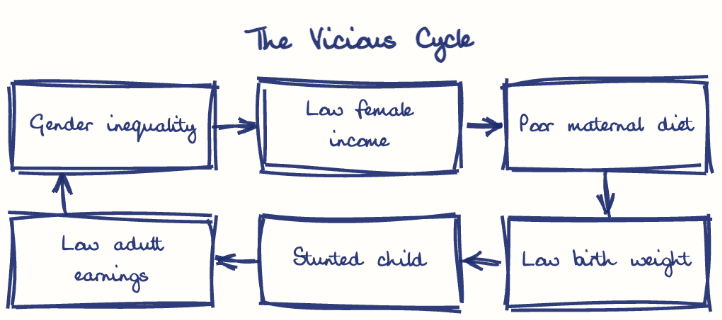
Can the vicious cycle of gender inequality, poverty and malnutrition be broken through microfinancing of women SHGs? Explain with examples.
In short
Microfinancing women's SHGs can weaken the cycle of gender inequality, poverty and malnutrition by putting income and voice in women's hands, but credit alone cannot break it without convergence with nutrition and health services. Kudumbashree's Amrutham Nutrimix units and Bihar's Jeevika show how.
Model answer
Ghissu Editorial · Verified 4 Oct 2026 · 279 words
Income in women's hands
Money women control goes more to children; Esther Duflo's 2003 South African pensions study found girls grew better when grandmothers received the pension.
Nutrition enterprises
Kudumbashree units make Amrutham Nutrimix for Kerala's anganwadis, and Madhya Pradesh's SHG federations run take-home-ration plants.
Groups as health platforms
Bihar's Jeevika uses SHG meetings to promote breastfeeding and hygiene, and its Didi ki Rasoi canteens feed hospital patients.
Credit is not food
The 2015 Hyderabad evaluation by Banerjee, Duflo and co-authors found no average health gain from microcredit alone.
Proxy borrowing
When husbands control the loan, women bear the debt without a say over food spending.
Over-indebtedness
Multiple loans, as in the 2010 Andhra Pradesh crisis, can force families to cut food to meet repayments.
Other causes
Sanitation, health care and early marriage also drive stunting and need convergence with POSHAN Abhiyaan, ICDS and NFSA.
This model answer is indicative and the model can make mistakes; please verify key facts independently.
Practise this question
1Get the answer sheet
Sized for this question.
2Write your answer
Timed, by hand.
3Get it marked
Your score and what to fix.
This chapter in the exam
SHGs6 questions
Asked in 6 of 14 sittings since 2013
- 2020"Micro-Finance as an anti-poverty vaccine, is aimed at asset creation and income security of the rural poor in India". Evaluate the role of the Self Help Groups in achieving the twin objectives along with empowering women in rural India.
- 2017"The emergence of the Self-Help Groups (SHGs) in contemporary times points to the slow but steady withdrawal of the State from developmental activities." Examine the role of the SHGs in developmental activities and the measures taken by the Government of India to promote the SHGs.
All 6 questions, sorted by sub-topic, with model answers and practice.
Question from the official UPSC Civil Services (Main) Examination 2021 paper. Answer written by Ghissu's engine and checked against our editorial standards. Found an error? Tell us and we correct it within 48 hours.