2021 · GS Paper 2 · Q14 · 15 marks
Explain the constitutional provisions under which Legislative Councils are established. Review the working and current status of Legislative Councils with suitable illustrations.
In short
Legislative Councils are created or abolished by Parliament under Article 169 after a special-majority Assembly resolution, and Article 171 fixes their mixed elected and nominated composition. They now function in six states, offering a second look on bills but often serving as political back doors.
Model answer
Ghissu Editorial · Verified 4 Oct 2026 · 286 words
West Bengal's 2021 resolution to revive its Council and Andhra Pradesh's 2020 vote to abolish one, later withdrawn, show that state bicameralism is optional under Article 169.
Constitutional Provisions for Legislative Councils
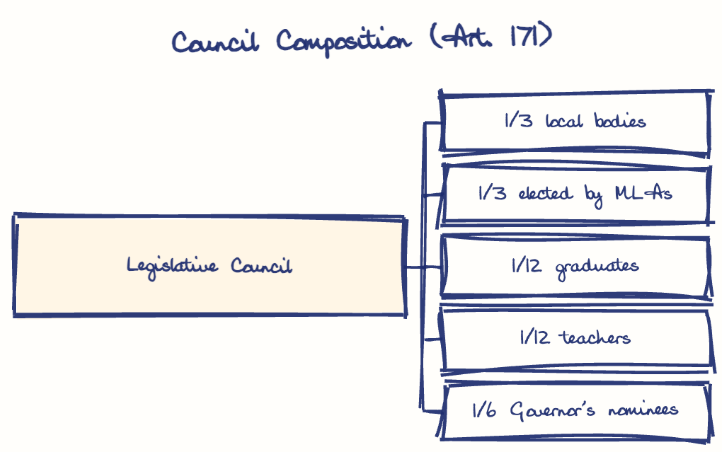
Council Composition (Art. 171) → Legislative Council → 1/3 local bodies → 1/3 elected by MLAs → 1/12 graduates → 1/12 teachers → 1/6 Governor's nominees
Creation and abolition
Parliament creates or abolishes a Council by ordinary law after the Assembly's special-majority resolution (Article 169), and this is not an Article 368 amendment.
Size and composition
Article 171 caps the Council at one-third of the Assembly with a floor of 40, mixing indirectly elected and expert nominated seats.
Permanent but subordinate
The Council is never dissolved, a third retiring every two years (Article 172), but it can only delay ordinary bills by up to four months and Money Bills by 14 days (Articles 197-198).
Six states
Councils exist in Andhra Pradesh, Bihar, Karnataka, Maharashtra, Telangana and Uttar Pradesh; Jammu and Kashmir's ended in 2019.
Second look
The Andhra Pradesh Council sent the three-capitals bills to a select committee in 2020, though the Assembly retaliated with an abolition resolution.
Back door to office
Nitish Kumar, Yogi Adityanath (2017) and Uddhav Thackeray (2020) held office as Council members without a direct election.
Stalled and politicised
Rajasthan and Assam Council Bills have been pending since 2013, and Maharashtra's 12 nominations stayed undecided from 2020 to 2022.
This model answer is indicative and the model can make mistakes; please verify key facts independently.
Practise this question
1Get the answer sheet
Sized for this question.
2Write your answer
Timed, by hand.
3Get it marked
Your score and what to fix.
This chapter in the exam
State Legislatures — Conduct of Business1 question
Asked in 1 of 14 sittings since 2013
Question from the official UPSC Civil Services (Main) Examination 2021 paper. Answer written by Ghissu's engine and checked against our editorial standards. Found an error? Tell us and we correct it within 48 hours.