2021 · GS Paper 3 · Q10 · 10 marks
Keeping in view India's internal security, analyse the impact of cross-border cyber attacks. Also discuss defensive measures against these sophisticated attacks.
In short
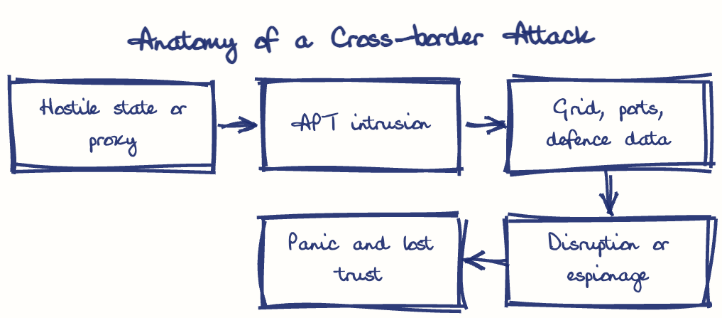
Cross-border cyber attacks threaten India's internal security by targeting critical infrastructure, spying on defence personnel and spreading misinformation, and India counters them through NCIIPC, CERT-In, the Defence Cyber Agency and trusted supply chains. Malware was found on the Kudankulam nuclear plant's administrative network in 2019.
Model answer
Ghissu Editorial · Verified 4 Oct 2026 · 290 words
Critical infrastructure at risk
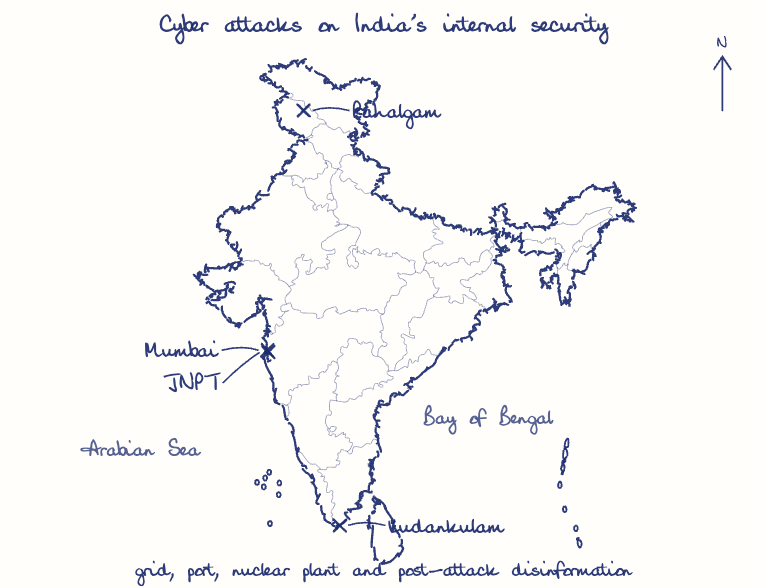
Malware on the Kudankulam nuclear plant's administrative network (2019) and the 2017 ransomware that halted a JNPT terminal show that power, nuclear and port systems are targets.
Espionage on defence
Pakistan-linked groups planted malware on defence personnel through fake domains after the 2025 Pahalgam attack (MP-IDSA, 2025).
Information warfare
Misinformation campaigns flooded social media after Pahalgam to mislead citizens and disturb public order.
Economic and strategic cost
Attacks on banks, ports and hospitals impose heavy losses, while deniable proxies let adversaries wage hybrid war below the threshold of open conflict.
Protecting the vital core
The National Critical Information Infrastructure Protection Centre (2014) guards power, telecom and finance, while CERT-In handles response.
Military capacity
The Defence Cyber Agency (2019) and the National Cyber Coordination Centre detect and respond to threats.
Securing the supply chain
The June 2020 ban on 59 Chinese apps and the National Security Directive on the Telecom Sector, in force from 2021 and allowing only trusted sources, close backdoors.
Skills and partnerships
Cyber Surakshit Bharat trains ministry security heads, and the Quad deepens threat-intelligence sharing.
This model answer is indicative and the model can make mistakes; please verify key facts independently.
Practise this question
1Get the answer sheet
Sized for this question.
2Write your answer
Timed, by hand.
3Get it marked
Your score and what to fix.
This chapter in the exam
Cyber Security9 questions
Asked in 9 of 14 sittings since 2013
- 2024Describe the context and salient features of the Digital Personal Data Protection Act, 2023.
- 2022What are the different elements of cyber security ? Keeping in view the challenges in cyber security, examine the extent to which India has successfully developed a comprehensive National Cyber Security Strategy.
All 9 questions, sorted by sub-topic, with model answers and practice.
Question from the official UPSC Civil Services (Main) Examination 2021 paper. Answer written by Ghissu's engine and checked against our editorial standards. Found an error? Tell us and we correct it within 48 hours.