2022 · GS Paper 1 · Q10 · 10 marks
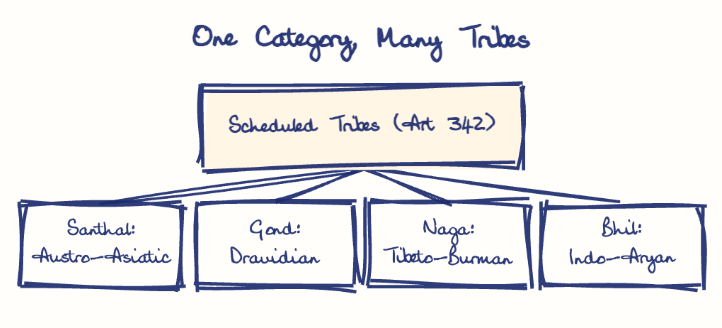
Given the diversities among tribal communities in India, in which specific contexts should they be considered as a single category ?
In short
Despite deep diversity in language, livelihood and faith, tribal communities should be treated as one category for constitutional safeguards, land and forest rights, protection from atrocity and displacement, and closing a shared development gap. ST literacy was 59% against 73% nationally in Census 2011.
Model answer
Ghissu Editorial · Verified 4 Oct 2026 · 281 words
Livelihood
Tribes range from hunter-gatherers such as the Jarawas of the Andamans, among the 75 PVTGs, to settled cultivators and the relatively prosperous, educated Meenas of Rajasthan.
Region and faith
Central Indian Adivasis under the Fifth Schedule differ from North-Eastern tribes, many of them Christian, under the Sixth.
Constitutional safeguards
Reservation in legislatures and jobs under Articles 330, 332 and 16(4), and the welfare mandate of Article 46, rest on a shared history of exclusion that no single tribe could claim alone.
Land, forest and self-rule
Every tribe depends on land and forest, so PESA (1996), the Forest Rights Act (2006) and the Niyamgiri judgment (2013) on gram sabha consent treat them as one rights-bearing group.
Atrocity and displacement
The Atrocities Act, 1989 covers all tribes alike, and the Xaxa Committee (2014) found tribals bearing a disproportionate share of displacement.
Development deficit
ST literacy was 59% against 73% nationally (Census 2011), justifying collective schemes like Eklavya Model Residential Schools.
This model answer is indicative and the model can make mistakes; please verify key facts independently.
Practise this question
1Get the answer sheet
Sized for this question.
2Write your answer
Timed, by hand.
3Get it marked
Your score and what to fix.
This chapter in the exam
Salient features of Indian Society, Diversity of India23 questions
Asked in 13 of 14 sittings since 2013
- 2026Unity in diversity remains the defining feature of Indian society despite the challenges from communalism and regionalism. Comment.
- 2026Is caste disappearing in urban India? Illustrate your answer with examples.
All 23 questions, sorted by sub-topic, with model answers and practice.
Question from the official UPSC Civil Services (Main) Examination 2022 paper. Answer written by Ghissu's engine and checked against our editorial standards. Found an error? Tell us and we correct it within 48 hours.