2022 · GS Paper 2 · Q20 · 15 marks
Clean energy is the order of the day.' Describe briefly India's changing policy towards climate change in various international fora in the context of geopolitics.
In short
India has shifted from defending common but differentiated responsibilities to leading clean-energy diplomacy, driven by energy security, rivalry with China and North-South bargaining. At COP26 in 2021 it pledged net zero by 2070, and its 2022 NDC targets 50 per cent non-fossil capacity by 2030.
Model answer
Ghissu Editorial · Verified 4 Oct 2026 · 289 words
Defensive equity
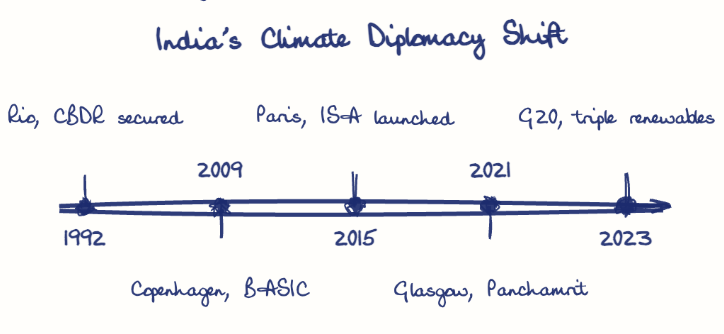
At Rio and Kyoto India secured "common but differentiated responsibilities", keeping binding cuts for the developed world.
Voluntary action
At Copenhagen (2009) it joined the BASIC bloc yet offered a 20 to 25 per cent intensity cut by 2020.
Solution provider
At Paris (2015) it co-founded the International Solar Alliance, and its 2022 NDC targets a 45 per cent intensity cut and 50 per cent non-fossil capacity by 2030.
Energy security
The 2022 Russia-Ukraine energy shock made renewables and the Green Hydrogen Mission a hedge against oil diplomacy.
China rivalry
China's grip on solar supply chains drives PLI schemes and Quad clean-energy cooperation.
North-South bargaining
India opposes the EU's CBAM, called the COP29 finance goal inadequate and backed the Loss and Damage Fund at COP27.
Finance and factories
Mobilise green finance through ISA and the G20 while scaling domestic solar and battery manufacturing.
Carbon market and just transition
Operationalise the Carbon Credit Trading Scheme to blunt CBAM, and publish a just-transition plan for coal regions.
This model answer is indicative and the model can make mistakes; please verify key facts independently.
Practise this question
1Get the answer sheet
Sized for this question.
2Write your answer
Timed, by hand.
3Get it marked
Your score and what to fix.
This chapter in the exam
Fora1 question
Asked in 1 of 14 sittings since 2013
Question from the official UPSC Civil Services (Main) Examination 2022 paper. Answer written by Ghissu's engine and checked against our editorial standards. Found an error? Tell us and we correct it within 48 hours.