2022 · GS Paper 2 · Q14 · 15 marks
Critically examine the procedures through which the Presidents of India and France are elected.
In short
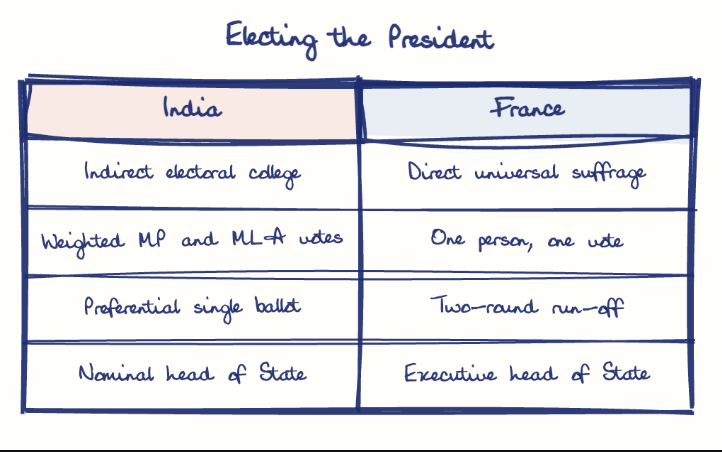
India elects its nominal President indirectly through a weighted federal electoral college using the single transferable vote, while France elects an executive President directly in a two-round run-off. Article 55's parity formula protects the States, whereas France's direct mandate brings polarisation and periodic cohabitation.
Model answer
Ghissu Editorial · Verified 4 Oct 2026 · 319 words
Federal college
Elected MPs and the elected MLAs of all States, Delhi and Puducherry vote, so the States share in choosing the Union's head.
Parity and STV
Article 55 weights MLA votes by the frozen 1971 population and matches MPs' total to MLAs' total; counting is by single transferable vote, and only V.V. Giri (1969) needed second preferences.
Merits and gaps
No rival mandate to the Prime Minister under Article 74, but the ruling coalition usually fixes the outcome and nominated members have no vote.
Run-off majority
Without an absolute majority the top two meet again, as Macron beat Marine Le Pen with about 58.5% in 2022.
Merits and gaps
Direct election, adopted by the 1962 referendum, gives legitimacy to a President who can dissolve the Assembly, but it polarises voters and has produced cohabitation in 1986, 1993 and 1997.
Update and retain
India should recalculate vote values after the first Census taken after 2026 and keep indirect election, which the Constituent Assembly chose to avoid rival mandates.
This model answer is indicative and the model can make mistakes; please verify key facts independently.
Practise this question
1Get the answer sheet
Sized for this question.
2Write your answer
Timed, by hand.
3Get it marked
Your score and what to fix.
This chapter in the exam
Comparison of the Indian Constitutional Scheme with That of Other Countries8 questions
Asked in 7 of 14 sittings since 2013
- 2026Examine how the separation of powers is practised in India compared to the rigid presidential model of the United States of America. In this context, compare the actual authority of the Indian Prime Minister with that of the President of the USA.
- 2025Compare and contrast the President's power to pardon in India and in the USA. Are there any limits to it in both the countries? What are preemptive pardons?
All 8 questions, sorted by sub-topic, with model answers and practice.
Question from the official UPSC Civil Services (Main) Examination 2022 paper. Answer written by Ghissu's engine and checked against our editorial standards. Found an error? Tell us and we correct it within 48 hours.