2022 · GS Paper 2 · Q12 · 15 marks
Discuss the essential conditions for exercise of the legislative powers by the Governor. Discuss the legality of re-promulgation of ordinances by the Governor without placing them before the Legislature.
In short
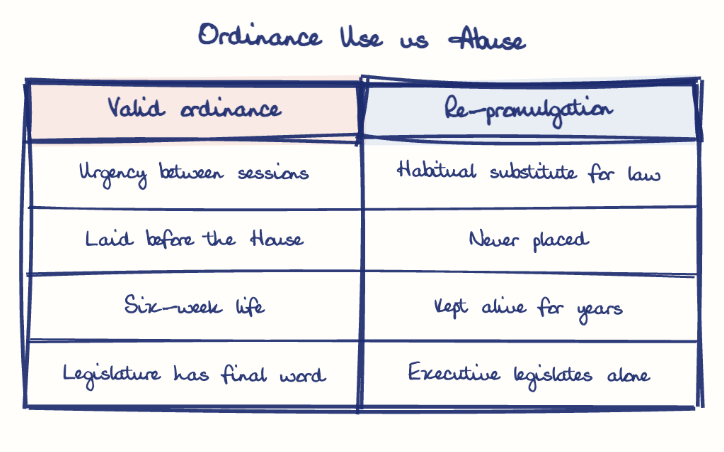
Under Article 213 the Governor may issue an ordinance only when the Legislature is not sitting, on ministerial advice, for genuine urgency and within State competence; it lapses six weeks after reassembly. Re-promulgation without laying was held unconstitutional in D.C. Wadhwa (1986) and Krishna Kumar Singh (2017).
Model answer
Ghissu Editorial · Verified 4 Oct 2026 · 299 words
House not in session
It can be issued only when the Assembly, or both Houses, is not sitting.
Urgency and advice
The Governor must be satisfied that immediate action is needed, acting on ministerial advice under Article 163 (Shamsher Singh, 1974); after the 44th Amendment this satisfaction is reviewable.
Limits of content
It is void wherever a State Act would be void, and needs the President's instructions where a Bill would need his sanction or reservation.
Laying and lapse
It must be laid before the Legislature and lapses six weeks after reassembly.
D.C. Wadhwa (1986)
Bihar re-promulgated 256 ordinances between 1967 and 1981, some for 14 years; the Court held this unconstitutional usurpation of legislative power.
Krishna Kumar Singh (2017)
Laying is mandatory and re-promulgation is a fraud on the Constitution, open to judicial review.
Narrow exception
Only fresh, proven urgency can justify re-issue; Kerala's 11 lapsed ordinances in 2022 show the dispute persists.
Fewer gaps
Fix minimum Assembly sittings, as the NCRWC (2002) urged, and require a reasoned statement of urgency with each ordinance.
This model answer is indicative and the model can make mistakes; please verify key facts independently.
Practise this question
1Get the answer sheet
Sized for this question.
2Write your answer
Timed, by hand.
3Get it marked
Your score and what to fix.
This chapter in the exam
Structure, Organization and Functioning of the States Executive2 questions
Asked in 2 of 14 sittings since 2013
Question from the official UPSC Civil Services (Main) Examination 2022 paper. Answer written by Ghissu's engine and checked against our editorial standards. Found an error? Tell us and we correct it within 48 hours.