2022 · GS Paper 2 · Q13 · 15 marks
"While the national political parties in India favour centralisation, the regional parties are in favour of State autonomy." Comment.
In short
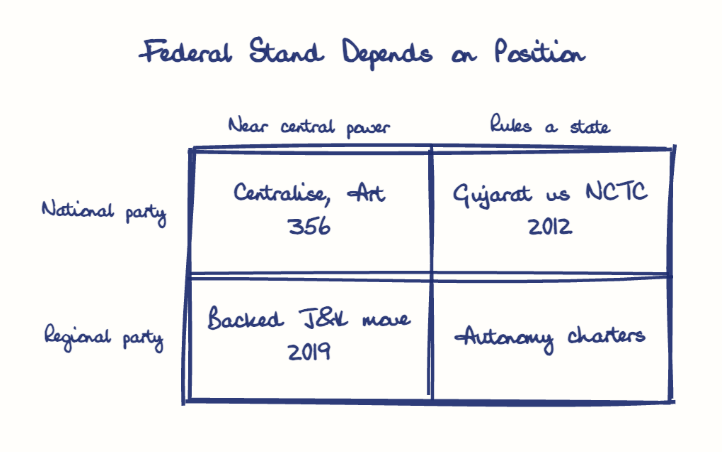
The claim is only partly true: national parties have centralised from the Centre and regional parties championed autonomy, but each reverses its stand when its position changes. Gujarat Chief Minister Narendra Modi opposed the NCTC in 2012, while the BJD and YSRCP backed the 2019 Jammu and Kashmir reorganisation.
Model answer
Ghissu Editorial · Verified 4 Oct 2026 · 297 words
Article 356
President's Rule was imposed over a hundred times, mostly by Congress governments, until S.R. Bommai (1994) allowed judicial review.
Concurrent List creep
The 42nd Amendment (1976) moved education and forests to the Concurrent List, and NEET still draws protests from Tamil Nadu.
Autonomy charters
The Rajamannar Committee and the Anandpur Sahib Resolution (1973) pressed for fiscal autonomy, prompting the Sarkaria Commission.
National parties in states
As Gujarat Chief Minister, Narendra Modi opposed the National Counter Terrorism Centre in 2012.
Regional parties near central power
The AIADMK, an NDA ally, with the BJD and YSRCP, backed the 2019 reorganisation of Jammu and Kashmir.
Centralisation within states
Parties of both kinds devolve only a fraction of the Twelfth Schedule functions to municipalities, as CAG audits show.
Decentralising national reforms
Congress enacted the 73rd and 74th Amendments, and the BJP accepted the 14th Finance Commission's 42% devolution.
Institutional bargaining
Revive the Inter-State Council, which last met in 2016, and consult states before using Concurrent List powers.
This model answer is indicative and the model can make mistakes; please verify key facts independently.
Practise this question
1Get the answer sheet
Sized for this question.
2Write your answer
Timed, by hand.
3Get it marked
Your score and what to fix.
This chapter in the exam
Devolution, Municipalities1 question
Asked in 1 of 14 sittings since 2013
Question from the official UPSC Civil Services (Main) Examination 2022 paper. Answer written by Ghissu's engine and checked against our editorial standards. Found an error? Tell us and we correct it within 48 hours.