2022 · GS Paper 3 · Q12 · 15 marks
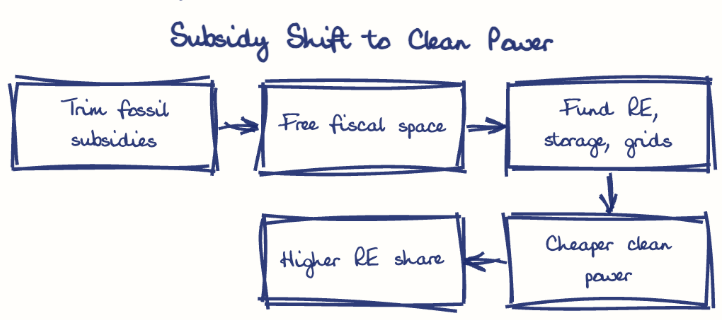
Do you think India will meet 50 percent of its energy needs from renewable energy by 2030 ? Justify your answer. How will the shift of subsidies from fossil fuels to renewables help achieve the above objective ? Explain.
In short
India has already met the capacity form of the target, with non-fossil sources at 50.07% of installed power capacity by mid-2025, but meeting half of total energy needs from renewables by 2030 is unlikely. Shifting subsidies to storage, grids and rooftop solar is the main lever to close that gap.
Model answer
Ghissu Editorial · Verified 4 Oct 2026 · 294 words
Capacity target met early
Non-fossil sources formed 50.07% of 484.82 GW installed capacity by mid-2025 (PIB, 2025), five years early.
Falling costs
Solar grew from 2.82 GW in 2014 to 107.9 GW by June 2025 as tariffs fell to Rs 2.15 per kWh.
Generation lags capacity
Low load factors mean coal still generates roughly three-quarters of electricity, and oil dominates transport.
Storage and grid gaps
The Central Electricity Authority projects a need for about 411 GWh of storage by 2031-32.
True price signals
Fuel deregulation of petrol (2010) and diesel (2014) lets clean power compete on real costs.
Storage and grids
Savings can fund viability gap funding for battery storage and Green Energy Corridors.
Mass adoption
PM Surya Ghar has reached nearly 24 lakh households and PM-KUSUM about 9.2 lakh solar pumps replacing diesel.
Track generation
Measure the renewable share of electricity and final energy, not capacity alone.
Targeted transition
Keep Ujjwala LPG support for the poor and retrain coal workers.
This model answer is indicative and the model can make mistakes; please verify key facts independently.
Practise this question
1Get the answer sheet
Sized for this question.
2Write your answer
Timed, by hand.
3Get it marked
Your score and what to fix.
This chapter in the exam
Energy2 questions
Asked in 2 of 14 sittings since 2013
Question from the official UPSC Civil Services (Main) Examination 2022 paper. Answer written by Ghissu's engine and checked against our editorial standards. Found an error? Tell us and we correct it within 48 hours.