2022 · GS Paper 4 · Q11 · 20 marks
Rakesh was working as Joint Commissioner in Transport Department of a city. As a part of his job profile, among others, he was entrusted with the task of overseeing the control and functioning of City Transport Department. A case of strike by the drivers' union of City Transport Department over the issue of compensation to a driver who died on duty while driving the bus came up before him for decision in the matter. He gathered that the driver (deceased) was plying Bus No. 528 which passed through busy and congested roads of the city. It so happened that near an intersection on the way, there was an accident involving the bus and a car driven by a middle-aged man. It was found that there was altercation between the driver and the car driver. Heated arguments between them led to fight and the driver gave him a blow. Lot of passerbys had gathered and tried to intervene but without success. Eventually, both of them were badly injured and profusely bleeding and were taken to the nearby hospital. The driver succumbed to the injuries and could not be saved. The middle-aged driver's condition was also critical but after a day, he recovered and was discharged. Police had immediately come at the spot of accident and FIR was registered. Police investigation revealed that the quarrel in question was started by the bus driver and he had resorted to physical violence. There was exchange of blows between them. The City Transport Department management is considering of not giving any extra compensation to the driver's (deceased) family. The family is very aggrieved, depressed and agitated against the discriminatory and non-sympathetic approach of the City Transport Department management. The bus driver (deceased) was 52 years of age, was survived by his wife and two school-college going daughters. He was the sole earner of the family. The City Transport Department workers' union took up this case and when found no favourable response from the management, decided to go on strike. The union's demand was two-fold. First was full extra compensation as given to other drivers who died on duty and secondly employment to one family member. The strike has continued for 10 days and the deadlock remains. (a) What are the options available to Rakesh to meet the above situation? (b) Critically examine each of the options identified by Rakesh. (c) What are the ethical dilemmas being faced by Rakesh? (d) What course of action would Rakesh adopt to diffuse the above situation?
In short
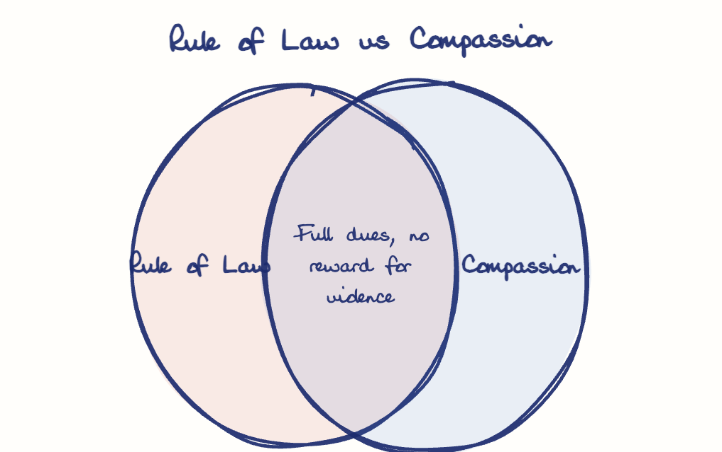
Rakesh should separate need from desert: release all dues, offer compassionate appointment to an eligible daughter and fund the daughters' education, while withholding only the extra award meant for blameless deaths. Umesh Kumar Nagpal (1994) tied compassionate appointment to relieving a sole earner's family's destitution.
Model answer
Ghissu Editorial · Verified 4 Oct 2026 · 298 words
(i) CAPITULATE [Empathetic-Humanitarian]
Conceding ends the strike but rewards violence, a Motivated Blindness to the FIR.
(ii) CONFRONT [Strict-Legal]
Rejecting both upholds discipline but is Moral Myopia that punishes innocent dependants.
(iii) EVADE [Procedural-Evasive]
Waiting is Moral Escapism; commuters pay.
(iv) COMPROMISE [Compromised-Hybrid]
A quiet deal is Dual-Standard Practice that invites future strikes.
(v) RECONCILE ✓ [Balanced]
Pay all dues and support the family, withhold only the extra award (recommended).
Relief to the family
Release terminal dues and offer compassionate appointment to an eligible daughter, which Umesh Kumar Nagpal (1994) [case] tied to relieving destitution.
End the strike
Run conciliation openly with alternative buses; the MSRTC strike of 2021-22 [current event] shows the cost of drift.
Long-term
A written policy on on-duty death benefits and road-rage training for drivers.
This model answer is indicative and the model can make mistakes; please verify key facts independently.
Practise this question
1Get the answer sheet
Sized for this question.
2Write your answer
Timed, by hand.
3Get it marked
Your score and what to fix.
This chapter in the exam
Workplace Integrity Under Pressure5 questions
Asked in 3 of 14 sittings since 2013
- 2023You are working as an executive in a nationalised bank for several years. One day one of your close colleagues tells you that her father is suffering from heart disease and needs surgery immediately to survive. She also tells you that she has no insurance and the operation will cost about ₹ 10 lakh. You are also aware of the fact that her husband is no more and that she is from a lower middle class family. You are empathetic about her situation. However, apart from expressing your sympathy, you do not have the resources to fund her. A few weeks later, you ask her about the well-being of her father and she informs you about his successful surgery and that he is recovering. She then confides in you that the bank manager was kind enough to facilitate the release of ₹ 10 lakh from a dormant account of someone to pay for the operation with a promise that it should be confidential and be repaid at the earliest. She has already started paying it back and will continue to do so until it is all returned. (a) What are the ethical issues involved? (b) Evaluate the behaviour of the bank manager from an ethical point of view. (c) How would you react to the situation?
- 2022The Supreme Court has banned mining in the Aravalli Hills to stop degradation of the forest cover and to maintain ecological balance. However, the stone mining was still prevalent in the border district of the affected State with connivance of certain corrupt forest officials and politicians. Young and dynamic SP who was recently posted in the affected district promised to himself to stop this menace. In one of his surprise checks with his team, he found loaded truck with stone trying to escape the mining area. He tried to stop the truck but the truck driver overrun the police officer, killing him on the spot and thereafter managed to flee. Police filed FIR but no breakthrough was achieved in the case for almost three months. Ashok who was the Investigative Journalist working with leading TV channel, suo moto started investigating the case. Within one month, Ashok got breakthrough by interacting with local people, stone mining mafia and government officials. He prepared his investigative story and presented to the CMD of the TV channel. He exposed in his investigative report the complete nexus of stone mafia working with blessing of corrupt police and civil officials and politicians. The politician who was involved in the mafia was no one else but local MLA who was considered to be very close to the Chief Minister. After going through the investigative report, the CMD advised Ashok to drop the idea of making the story public through electronic media. He informed that the local MLA was not only the relative of the owner of the TV channel but also had unofficially 20 percent share in the channel. The CMD further informed Ashok that his further promotion and hike in pay will be taken care of in addition the soft loan of ₹ 10 lakhs which he has taken from the TV channel for his son's chronic disease will be suitably adjusted if he hands over the investigative report to him. (a) What are the options available with Ashok to cope up with the situation? (b) Critically evaluate/examine each of the options identified by Ashok. (c) What are the ethical dilemmas being faced by Ashok? (d) Which of the options, do you think, would be the most appropriate for Ashok to adopt and why? (e) In the above scenario, what type of training would you suggest for police officers posted to such districts where stone mining illegal activities are rampant?
All 5 questions, sorted by sub-topic, with model answers and practice.
Question from the official UPSC Civil Services (Main) Examination 2022 paper. Answer written by Ghissu's engine and checked against our editorial standards. Found an error? Tell us and we correct it within 48 hours.