2023 · GS Paper 2 · Q4 · 10 marks
Compare and contrast the British and Indian approaches to Parliamentary sovereignty.
In short
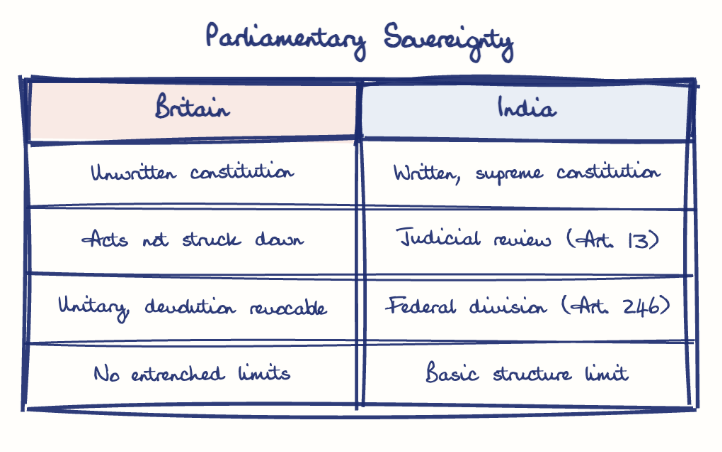
Britain's Parliament is legally sovereign under an unwritten constitution, while India's Parliament works within a supreme written Constitution, judicial review and a federal division of powers. Kesavananda Bharati (1973) bars India's Parliament from altering the basic structure.
Model answer
Ghissu Editorial · Verified 4 Oct 2026 · 289 words
Source of supremacy
Britain's Parliament is the highest legal authority, whereas India's Parliament is a creation of a supreme, written Constitution.
Judicial review
British courts can only declare incompatibility under the Human Rights Act, 1998; India's Supreme Court struck down the NJAC amendment in 2015.
Federal limits
Westminster may legislate on any subject despite devolution to Scotland, while India's Parliament is bound by the Seventh Schedule except under Article 249 or an emergency.
Entrenchment
No British Parliament binds its successor, but Article 368 needs special majorities, and Minerva Mills (1980) made limited amending power a basic feature.
Control of the executive
Miller (2017) required an Act of Parliament to start Brexit, and Article 75(3) makes Indian ministers collectively responsible to the Lok Sabha.
Privileges
Article 105 originally tied Indian privileges to those of the House of Commons, so both legislatures guard their own proceedings.
Narrowing gap
EU law, as in Factortame (1990), and devolution conventions limited British sovereignty in practice, bringing it closer to India's model until Brexit restored formal supremacy.
This model answer is indicative and the model can make mistakes; please verify key facts independently.
Practise this question
1Get the answer sheet
Sized for this question.
2Write your answer
Timed, by hand.
3Get it marked
Your score and what to fix.
This chapter in the exam
Parliament — Powers & Functioning4 questions
Asked in 4 of 14 sittings since 2013
- 2024The growth of cabinet system has practically resulted in the marginalisation of the parliamentary supremacy. Elucidate.
- 2021To what extent, in your view, the Parliament is able to ensure accountability of the executive in India?
All 4 questions, sorted by sub-topic, with model answers and practice.
Question from the official UPSC Civil Services (Main) Examination 2023 paper. Answer written by Ghissu's engine and checked against our editorial standards. Found an error? Tell us and we correct it within 48 hours.