2023 · GS Paper 2 · Q17 · 15 marks
"Development and welfare schemes for the vulnerable, by its nature, are discriminatory in approach." Do you agree ? Give reasons for your answer.
In short
Development and welfare schemes for the vulnerable differentiate rather than discriminate, since classification aimed at equalising opportunity is what Articles 14 to 16 envisage, though poor targeting and biased delivery can make them discriminatory. N.M. Thomas (1975) held special provisions a facet of equality.
Model answer
Ghissu Editorial · Verified 4 Oct 2026 · 291 words
In Janhit Abhiyan (2022), the Supreme Court upheld the 10% EWS quota, but two dissenting judges called the exclusion of poor SCs, STs and OBCs discriminatory. Welfare for the vulnerable must classify; the question is whether that is discrimination or equality under Article 14.
Why Targeted Schemes Appear Discriminatory
1. Exclusion by category: Equally poor people outside a group are left out, as the EWS dissent argued. 2. Elite capture: The better-off within groups corner benefits, hence the creamy layer in Indra Sawhney (1992) and SC sub-classification in Davinder Singh (2024). 3. Bias in delivery: Students in Uttarakhand's Champawat boycotted a Dalit cook's mid-day meals in 2021, showing prejudice in implementation.
Reasonable classification
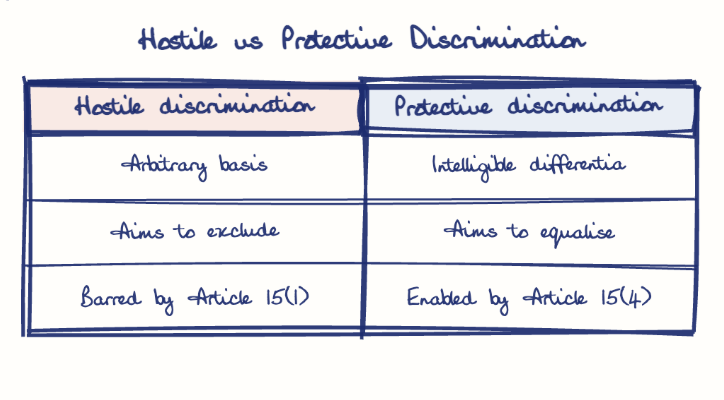
Article 14 allows classification with an intelligible differentia and a rational nexus, as held in Anwar Ali Sarkar (1952).
Substantive equality
Articles 15(4), 16(4) and 46 enable special provisions, which N.M. Thomas (1975) called a facet of equality.
Universal schemes coexist
Jan Dhan and the 2024 extension of PM-JAY to everyone aged 70 and above are not exclusionary.
Fairer targeting
Combine group identity with deprivation data and dynamic registries in place of SECC 2011 lists.
Universal floor
Guarantee basic services to all, with targeted add-ons reviewed for outcomes.
This model answer is indicative and the model can make mistakes; please verify key facts independently.
Practise this question
1Get the answer sheet
Sized for this question.
2Write your answer
Timed, by hand.
3Get it marked
Your score and what to fix.
This chapter in the exam
Welfare Schemes9 questions
Asked in 6 of 14 sittings since 2013
- 2022Reforming the government delivery system through the Direct Benefit Transfer Scheme is a progressive step, but it has its limitations too. Comment.
- 2022Besides the welfare schemes, India needs deft management of inflation and unemployment to serve the poor and the underprivileged sections of the society. Discuss.
All 9 questions, sorted by sub-topic, with model answers and practice.
Question from the official UPSC Civil Services (Main) Examination 2023 paper. Answer written by Ghissu's engine and checked against our editorial standards. Found an error? Tell us and we correct it within 48 hours.