2023 · GS Paper 3 · Q12 · 15 marks
Distinguish between 'care economy' and 'monetized economy'. How can care economy be brought into monetized economy through women empowerment?
In short
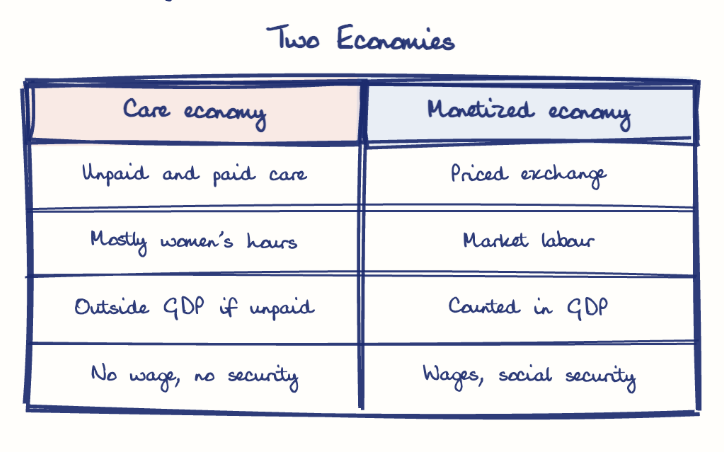
The care economy covers paid and unpaid work of looking after people, mostly done by women outside GDP, while the monetized economy covers priced, wage-earning exchange. Care can be monetized through creches, skilling, collectives like SEWA's Sangini cooperative and legal recognition such as Kirti (2021).
Model answer
Ghissu Editorial · Verified 4 Oct 2026 · 296 words
Care economy
It covers direct care of children, the elderly and the sick and indirect work such as cooking and fetching water, whether unpaid at home or paid, as with nurses and Anganwadi workers.
Monetized economy
Here goods and services carry a price, so they enter GDP and the worker earns a wage and social security; the UN System of National Accounts excludes household services produced for own use.
Freeing time
Palna creches, Jal Jeevan Mission taps and Ujjwala LPG cut unpaid hours and release women for paid work.
Skilling for care jobs
Certified nursing and eldercare training, and the India-Japan Specified Skilled Worker pact (2021), turn care skills into wages.
Collectives
SEWA's Sangini childcare cooperative and DAY-NRLM self-help groups let women sell care services collectively.
Legal recognition
The Supreme Court in Kirti (2021) valued a homemaker's work, and Tamil Nadu's Kalaignar Magalir Urimai Thogai (2023) pays Rs 1,000 a month for unpaid labour.
Worker status
ASHA and Anganwadi workers on honoraria need minimum wages, as the 45th Indian Labour Conference (2013) urged, and paternity leave should share care.
This model answer is indicative and the model can make mistakes; please verify key facts independently.
Practise this question
1Get the answer sheet
Sized for this question.
2Write your answer
Timed, by hand.
3Get it marked
Your score and what to fix.
This chapter in the exam
Inclusive Growth11 questions
Asked in 9 of 14 sittings since 2013
- 2026Examine the view that financial inclusion is an integral part of social and economic inclusion in a country like India. Also throw light on the usefulness of the R.B.I.'s Financial Inclusion Index. (Answer in 150 words)
- 2022Is inclusive growth possible under market economy ? State the significance of financial inclusion in achieving economic growth in India.
All 11 questions, sorted by sub-topic, with model answers and practice.
Question from the official UPSC Civil Services (Main) Examination 2023 paper. Answer written by Ghissu's engine and checked against our editorial standards. Found an error? Tell us and we correct it within 48 hours.