2023 · GS Paper 3 · Q10 · 10 marks
The use of unmanned aerial vehicles (UAVs) by our adversaries across the borders to ferry arms/ammunitions, drugs, etc., is a serious threat to the internal security. Comment on the measures being taken to tackle this threat.
In short
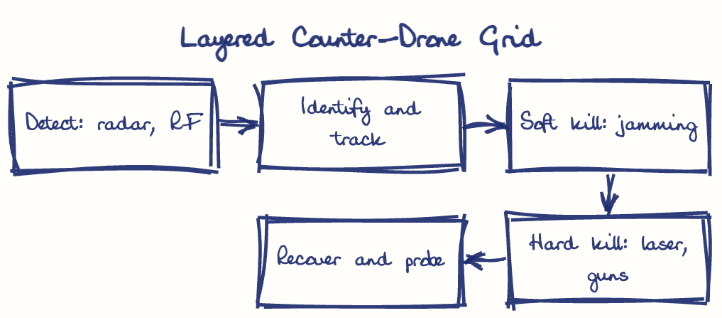
India is countering cross-border drones through a layered grid of detection, jamming and hard-kill systems, backed by drone rules and wider BSF jurisdiction, though coverage and command gaps remain. DRDO's D4 system detects, jams and destroys rogue drones and is deployed against such threats.
Model answer
Ghissu Editorial · Verified 4 Oct 2026 · 279 words
Technology shield
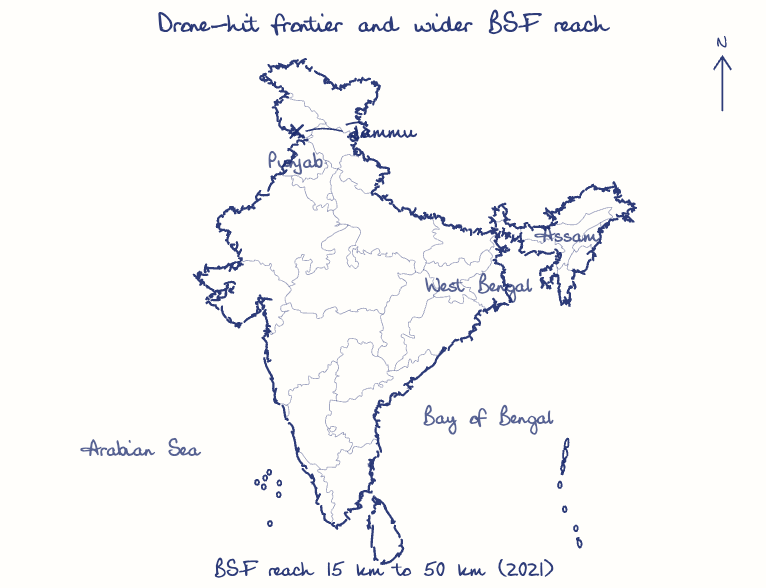
DRDO's D4 system detects, jams and destroys rogue drones, and the BSF has deployed anti-drone units along the Punjab frontier.
Legal framework
The MHA's National Counter Rogue Drone Guidelines (2019), the Drone Rules 2021 with Digital Sky zones, and the 2022 ban on foreign drone imports make civilian drones traceable.
Wider jurisdiction
Extending the BSF's search-and-seizure reach from 15 km to 50 km in October 2021 lets it chase drops inland, while the NIA probes the receiving modules and villagers are rewarded for tips.
Coverage deficit
Small drones flying low at night evade conventional radars, and anti-drone units cover only stretches of the frontier.
Cost and deniability
Cheap commercial drones flown from across the border cost far less than the systems that stop them, and their handlers stay beyond Indian law.
Fragmented command
The BSF, state police, NCB and Air Force lack a single counter-drone command, and imported sensors slow any scale-up.
This model answer is indicative and the model can make mistakes; please verify key facts independently.
Practise this question
1Get the answer sheet
Sized for this question.
2Write your answer
Timed, by hand.
3Get it marked
Your score and what to fix.
This chapter in the exam
Organized Crime and Terrorism6 questions
Asked in 6 of 14 sittings since 2013
- 2026Discuss counterfeit currency and money laundering as major sources of terror funding in India. State the actions being taken at International level to check these menaces. Highlight the role of Financial Action Task Force (FATF) and methods of compliance by its member states in preventing terror funding. (Answer in 250 words)
- 2024Explain how narco-terrorism has emerged as a serious threat across the country. Suggest suitable measures to counter narco-terrorism.
All 6 questions, sorted by sub-topic, with model answers and practice.
Question from the official UPSC Civil Services (Main) Examination 2023 paper. Answer written by Ghissu's engine and checked against our editorial standards. Found an error? Tell us and we correct it within 48 hours.