2023 · GS Paper 3 · Q14 · 15 marks
What are the direct and indirect subsidies provided to farm sector in India? Discuss the issues raised by the World Trade Organization (WTO) in relation to agricultural subsidies.
In short
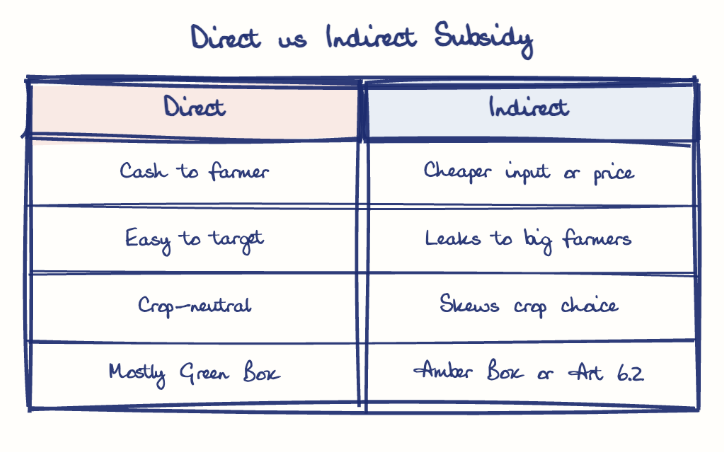
India subsidises farmers directly through cash transfers like PM-KISAN and indirectly through cheap fertiliser, power, credit, insurance and MSP, while the WTO contests MSP as trade-distorting Amber Box support. India invoked the Bali peace clause for rice in 2018-19 because its support is measured against frozen 1986-88 prices.
Model answer
Ghissu Editorial · Verified 4 Oct 2026 · 318 words
Direct support
PM-KISAN (2019), Telangana's Rythu Bandhu (2018), Madhya Pradesh's Bhavantar price-deficiency payments (2017) and loan waivers put cash in farmers' hands.
Indirect support
Urea at a fixed ₹242 per 45 kg bag, the Nutrient Based Subsidy (2010), free farm power in Punjab, MSP for 22 crops, 4% crop loans and PMFBY's 2% kharif premium lower costs without cash.
MSP as Amber Box
Price support is capped at 10% of production value and measured against a frozen 1986-88 reference price, so India invoked the Bali peace clause for rice in 2018-19.
Stockholding and disputes
A permanent public stockholding solution eluded MC13 (2024), while a WTO panel ruled against India's sugar support in December 2021.
Uneven rulebook
About 95% of the USD 148.8 billion AMS entitlements belong to developed members, led by the EU, US, Japan and UK (RIS, 2025), who also shelter decoupled payments in the uncapped Green Box.
Diplomacy and redesign
India should press a permanent stockholding solution with the G33 and shift support towards decoupled transfers, research and storage, with farmer-level DBT for fertiliser and power.
This model answer is indicative and the model can make mistakes; please verify key facts independently.
Practise this question
1Get the answer sheet
Sized for this question.
2Write your answer
Timed, by hand.
3Get it marked
Your score and what to fix.
This chapter in the exam
Farm Subsidies and Minimum Support Prices8 questions
Asked in 8 of 14 sittings since 2013
- 2026Discuss the different types of subsidies and supports provided by the Government of India to agricultural sector. Examine the related issues pertaining to Agreement on Agriculture of World Trade Organisation (WTO). (Answer in 250 words)
- 2018What do you mean by Minimum Support Price (MSP)? How will MSP rescue the farmers from the low income trap?
All 8 questions, sorted by sub-topic, with model answers and practice.
Question from the official UPSC Civil Services (Main) Examination 2023 paper. Answer written by Ghissu's engine and checked against our editorial standards. Found an error? Tell us and we correct it within 48 hours.